
Why Is My AC Compressor Not Turning On?
Causes, safe checks and when to call a professional
Expert Answer: AC Compressor Not Turning On
A compressor that will not start while the rest of the system operates points at a short list: a failed run or start capacitor, a contactor not delivering voltage to the compressor terminals, an internal thermal overload that has opened because the compressor is hot, a pressure switch locking the system out due to refrigerant charge, or windings that have failed electrically. If the outdoor fan spins but the compressor is silent, a capacitor is the statistical favorite. If the compressor tries to start and trips within seconds, suspect overload, locked rotor or hard-start issues. Either way this is technician territory — the compartment contains lethal voltage.
Check these 3 things first
- 1Confirm whether the outdoor fan spins while the compressor stays silent.
- 2Listen for a hum, a single click, or repeated clicking during the attempted start.
- 3Feel whether the outdoor cabinet is unusually hot to the touch.
How Serious Is This?
GREEN
Usually Manageable
Often resolved with basic homeowner checks and routine maintenance.
YELLOW — this issue's severity level
Inspection Recommended(this issue)
Worth a professional diagnosis soon to avoid a larger repair.
RED
Potentially Serious
Stop using the system and get professional help right away.
Most Likely Causes of an AC Compressor Not Turning On
1. Failed run capacitor
Dual-run capacitors serve both the fan and the compressor. The compressor side can fail while the fan side still works, producing exactly this symptom.
2. Worn contactor
Pitted contacts may pass enough current for the fan but not enough to start the compressor.
3. Internal thermal overload open
An overheating compressor opens its internal protector and will not restart until it cools, sometimes for hours.
4. Low- or high-pressure switch lockout
Refrigerant loss or a blocked condenser can open a pressure switch that prevents compressor operation.
5. Locked rotor or mechanical seizure
The compressor draws high current and hums but cannot turn. Usually terminal.
6. Failed or shorted windings
An electrically failed motor will not start and may trip the breaker.
7. Missing hard-start component
Some systems rely on a start capacitor or potential relay; when it fails, the compressor cannot get moving.
Safe Homeowner Checks for an AC Compressor Not Turning On
- Confirm the outdoor fan spins while the compressor stays silent.
- Listen for a hum or a click-and-stop pattern.
- Check the breaker and disconnect.
- Note whether the unit has been running hot or short cycling recently.
- Feel whether the outdoor cabinet is very hot — a sign of overload tripping.
- Shut the system off and let it cool for a few hours, then try once more.
- Do not open the electrical compartment.
Stop and get help if you notice
- • Breaker tripping when the compressor tries to start.
- • Loud buzz and immediate shutdown.
- • Burnt odor from the outdoor unit.
2-Minute Tests for an AC Compressor Not Turning On
Each test isolates one specific cause so you know what you are dealing with before anyone quotes you a repair. Stop immediately if anything feels unsafe.
Fan-versus-compressor sound test
About 3 minutesTools: None
Tests for: Failed run capacitor
- Start a cooling call and walk to the outdoor unit.
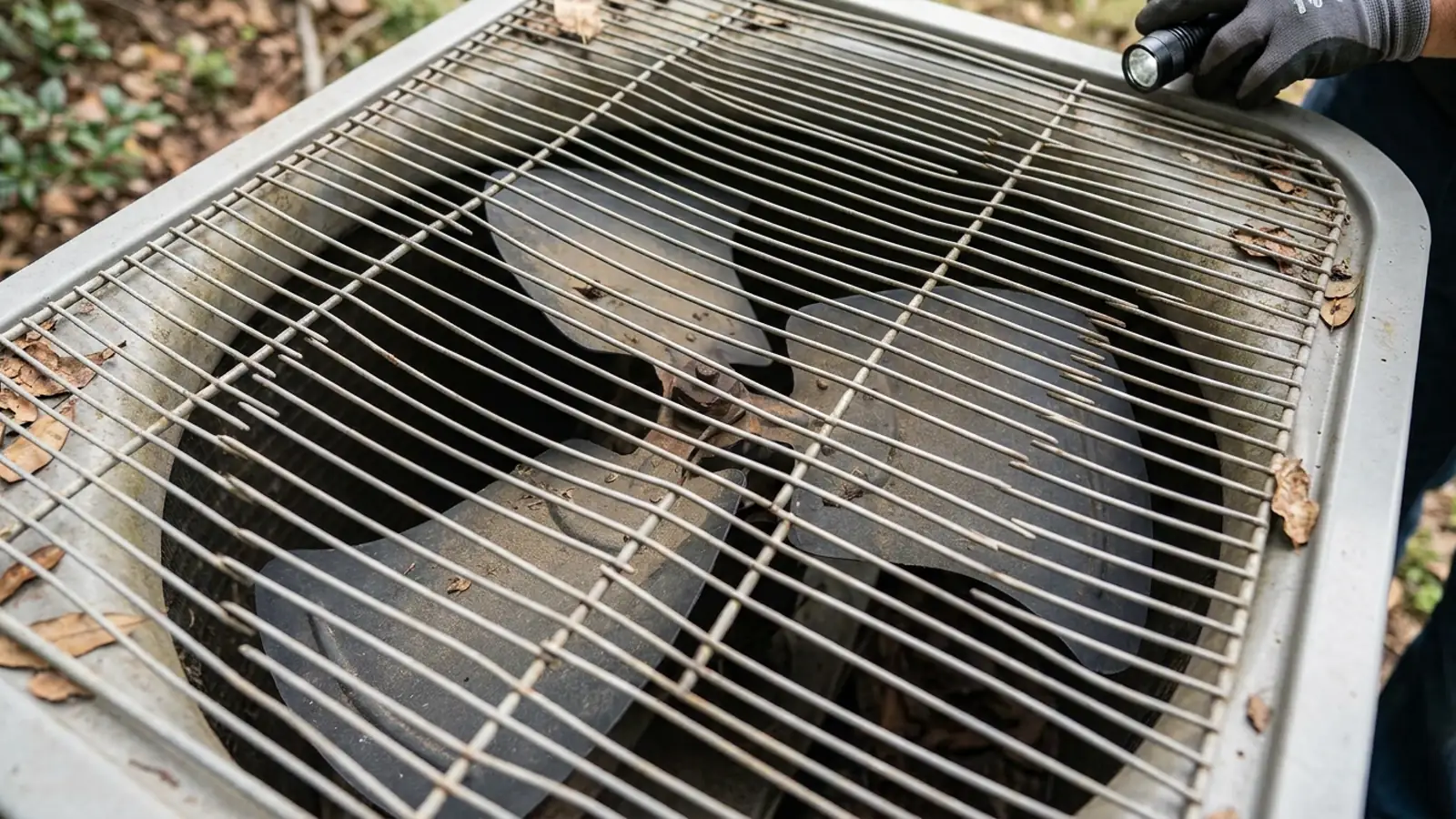
- Watch whether the fan blade is turning through the top grille.
- Listen closely for a steady hum with no compressor sound underneath.
- Do not touch or open the unit at any point.
- Normal result
- Both the fan spins and a compressor sound is present.
- Problem result
- The fan spins but only a hum is heard, with no compressor operation.
What it means: A fan that runs while the compressor stays silent points strongly to the compressor side of a dual-run capacitor failing independently.
Heat and short-cycle history check
About 3 minutesTools: None
Tests for: Internal thermal overload open
- Recall whether the unit has been running longer or harder than usual recently.
- Feel the outside of the cabinet for excess heat without touching any vents.
- Turn the thermostat off entirely and wait at least one hour.
- Restart the cooling call after the wait.
- Normal result
- The compressor starts normally after the cooldown period.
- Problem result
- The compressor still will not start after an hour of rest.
What it means: A compressor that restarts after cooling was likely protected by its internal overload; one that still fails needs electrical or mechanical diagnosis.
Hum-and-stop pattern check
About 2 minutesTools: None
Tests for: Locked rotor or mechanical seizure
- Listen at a safe distance during a start attempt.
- Note whether you hear a hum for one or two seconds followed by silence.
- Turn the system off at the thermostat if this pattern repeats.
- Normal result
- The compressor starts and runs smoothly with no repeated humming.
- Problem result
- A brief hum repeats every attempt, then stops.
What it means: This pattern is consistent with a locked rotor or an overload tripping on high starting current, which usually signals a mechanical or winding failure.
What Fixing an AC Compressor Not Turning On Typically Costs
Capacitor replacement
- DIY
- Not a DIY repair
- Professional
- $150-$400
- Typical time
- 30-60 minutes
Contactor replacement
- DIY
- Not a DIY repair
- Professional
- $150-$350
- Typical time
- 30-60 minutes
Hard-start kit installation
- DIY
- Not a DIY repair
- Professional
- $150-$350
- Typical time
- 30-60 minutes
Pressure switch or lockout diagnosis
- DIY
- Not a DIY repair
- Professional
- $150-$350 diagnostic
- Typical time
- 1 hour
Compressor replacement
- DIY
- Not a DIY repair
- Professional
- $1,800-$3,500+
- Typical time
- 3-6 hours
| Problem | DIY cost | Professional cost | Typical time |
|---|---|---|---|
| Capacitor replacement | Not a DIY repair | $150-$400 | 30-60 minutes |
| Contactor replacement | Not a DIY repair | $150-$350 | 30-60 minutes |
| Hard-start kit installation | Not a DIY repair | $150-$350 | 30-60 minutes |
| Pressure switch or lockout diagnosis | Not a DIY repair | $150-$350 diagnostic | 1 hour |
| Compressor replacement | Not a DIY repair | $1,800-$3,500+ | 3-6 hours |
Ranges are national estimates for planning only. Local labor rates, equipment access and parts availability change what you will actually be quoted.
Working Through an AC Compressor Not Turning On
Does the outdoor fan run while the compressor stays silent?
Yes: Power reaches the unit — suspect the capacitor's compressor side, the contactor or an overload.
No: Suspect no power or no control call to the unit at all.
Does the compressor hum for a second or two and stop?
Yes: Locked rotor, weak capacitor or overload trip. Shut it off to avoid damage.
No: Continue.
Has the compressor been running hot or short cycling recently?
Yes: Overload protection may be involved — let it cool and have it diagnosed.
No: Have the electrical components and refrigerant pressures tested.
What the technician will check
- Capacitor microfarad testing on both terminals.
- Contactor voltage in and out.
- Compressor winding resistance and ground testing.
- Locked-rotor amperage measurement.
- Refrigerant pressures and pressure-switch status.
- Hard-start kit assessment where applicable.
Repair considerations
- • Capacitor and contactor replacement is inexpensive and resolves a large share of these calls.
- • A hard-start kit can extend the life of a compressor that is slow to start, but it treats a symptom.
- • Compressor replacement is a major expense; warranty status, refrigerant type and system age all matter.
- • On systems past roughly 12–15 years, compressor failure usually favors full replacement.
What this actually means
The compressor is the heart of the refrigeration cycle. Without it, refrigerant does not circulate and no heat is moved, regardless of what the fan and blower do. Because the compressor is also the most expensive component, correctly identifying whether the failure is in the compressor itself or in the inexpensive parts that start it is the single most valuable diagnostic step.
When to Call an HVAC Professional About an AC Compressor Not Turning On
- The compressor hums, buzzes or trips the breaker.
- The fan runs but the compressor never starts.
- You suspect the system is locked out on a pressure switch.
- Cooling has been declining and now the compressor will not run.
Preventing an AC Compressor Not Turning On From Coming Back
- • Keep the condenser coil clean to reduce compressor operating temperature.
- • Replace weak capacitors proactively at maintenance.
- • Fix short cycling early — starts are what wear compressors out.
- • Address refrigerant leaks rather than repeatedly topping off.
Worth doing yourself
- • Let the unit rest for an hour if it has been running hot or short cycling.
- • Reset the breaker once and observe the start attempt.
- • Report the exact sound pattern (silence, hum, click) to whoever services the unit.
Do not waste money on
- • Opening the electrical compartment near the capacitor or contactor.
- • Repeated restart attempts on a compressor that hums and trips.
- • Assuming a hard-start kit fixes a compressor that is already failing electrically.
Related Problems: AC Compressor Not Turning On
- YELLOW — Inspection RecommendedAC Won't StartWhy Is My AC Unit Not Turning On?Read this next if the equipment cabinet itself will not start — visitor is standing at the outdoor condenser or air handler observing hardware behaviour.View answer
- YELLOW — Inspection RecommendedAC Not CoolingWhy Is My AC Not Cooling But Fan Is Running?Read this next if indoor blower operates normally but the refrigeration cycle may not be operating — visitor has already isolated the fan as working.View answer
- YELLOW — Inspection RecommendedAC Won't StartWhy Is My AC Fan Not Turning On?Read this next if a fan is not spinning — page must first distinguish the indoor blower from the outdoor condenser fan, since they fail differently.View answer
- YELLOW — Inspection RecommendedAC Won't StartWhy Is My AC Not Turning On?Read this next if nothing happens when the thermostat calls — focus on the power and control chain from breaker to contactor.View answer
- YELLOW — Inspection RecommendedAC Operation ProblemsWhy Is My AC Short Cycling?Read this next if compressor starts and stops after only a few minutes, repeatedly — a cycling behaviour problem rather than a temperature complaint.View answer
- GREEN — Usually ManageableAC NoisesWhy Is My AC So Loud?Read this next if overall sound level has increased across the whole system — a volume complaint rather than a specific identifiable sound.View answer
- All AC Won't Start problemsBrowse category
Frequently Asked Questions About an AC Compressor Not Turning On
Guidance this page draws on
- ACCA — Compressor electrical fault isolation procedures.
- HVAC manufacturer service literature — Capacitor and overload specifications for residential compressors.