
Why Is My AC Compressor Not Turning On in My Car?
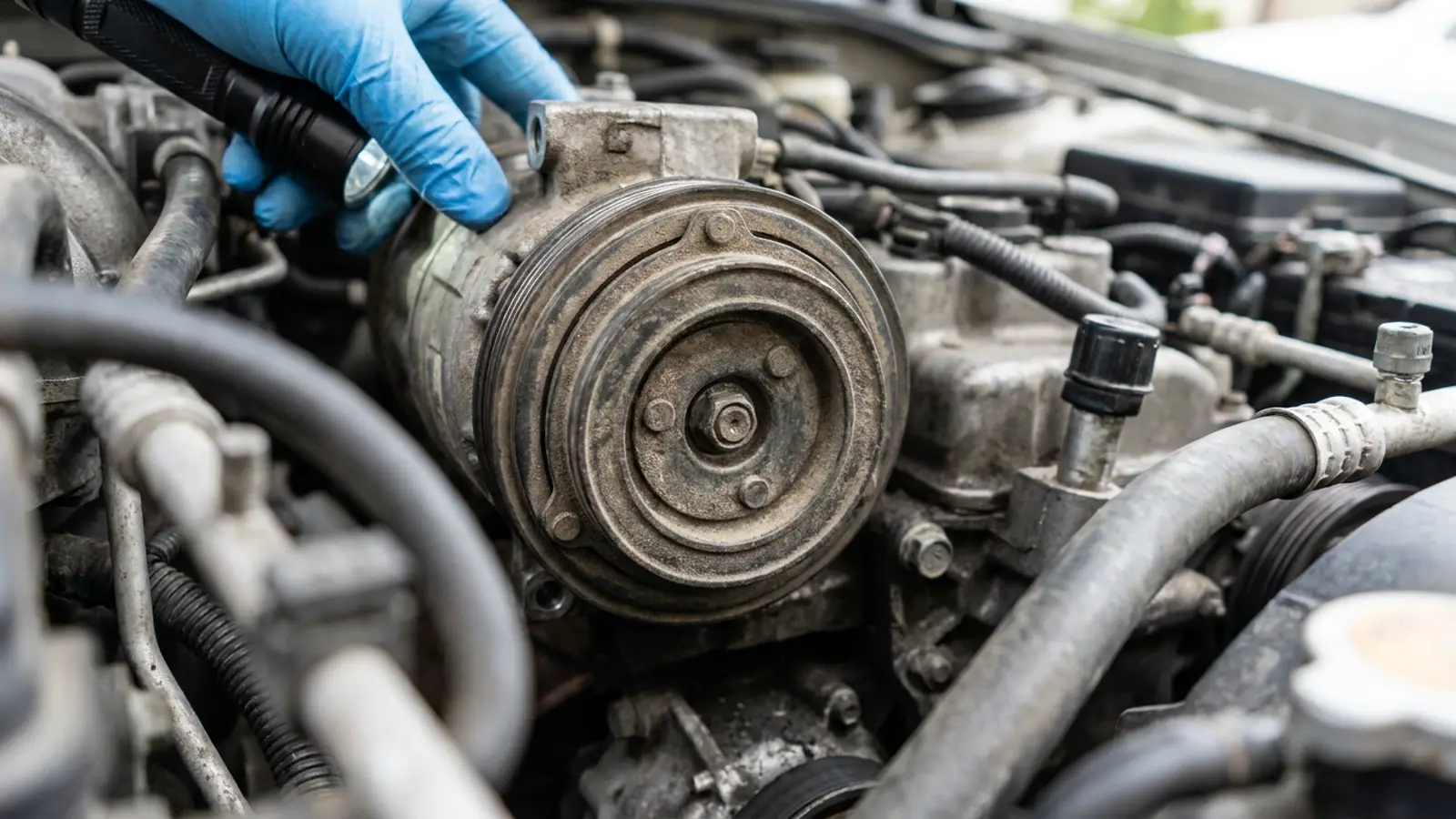
Causes, safe checks and when to call a professional
Expert Answer: AC Compressor Not Turning On in My Car
Vehicle A/C systems deliberately refuse to run the compressor when refrigerant pressure is too low, so the most common reason the clutch does not engage is simply low charge triggering the low-pressure switch. After that come a blown fuse or failed relay, a failed clutch coil or excessive clutch air gap, a pressure sensor fault, and control-side issues such as a failed HVAC module or a request being blocked by the engine computer. Watch the compressor pulley with the A/C on: pulley spinning with a stationary center hub means the clutch is not engaging.
Check these 3 things first
- 1With the engine running and A/C on max, look at the compressor pulley center hub.
- 2Check the A/C fuse and relay using the fuse box diagram.
- 3Listen for a click at the compressor when the A/C is switched on.
How Serious Is This?
GREEN — this issue's severity level
Usually Manageable(this issue)
Often resolved with basic homeowner checks and routine maintenance.
YELLOW
Inspection Recommended
Worth a professional diagnosis soon to avoid a larger repair.
RED
Potentially Serious
Stop using the system and get professional help right away.
Most Likely Causes of an AC Compressor Not Turning On in My Car
1. Low refrigerant tripping the low-pressure cutout
The most common cause. The system protects the compressor from running without lubrication.
2. Blown fuse or failed relay
Inexpensive and easy to check with the owner's manual fuse diagram.
3. Failed clutch coil or excessive air gap
The clutch cannot generate enough magnetic force to engage.
4. Faulty pressure sensor or switch
A failed sensor reports out-of-range pressure and blocks engagement.
5. Engine computer disabling A/C
Some vehicles cut A/C under high engine load, overheating, or with certain fault codes present.
6. HVAC control head or wiring fault
The request never reaches the compressor circuit.
7. Seized compressor
A mechanically seized compressor will not turn even with a healthy clutch signal.
Safe Checks for an AC Compressor Not Turning On in My Car
- With the engine running and A/C on max, look at the compressor pulley center hub.
- Check the A/C fuse and relay using the fuse box diagram.
- Listen for a click at the compressor when the A/C is switched on.
- Check whether the engine is running hot, which can disable A/C on some vehicles.
- Note any dashboard warning lights.
- Never open a pressurized A/C line or attempt refrigerant service yourself.
- Keep hands and tools clear of belts, pulleys and fans whenever the engine is running.
Stop and get help if you notice
- • Grinding when the clutch attempts to engage.
- • Burning smell from the compressor area.
- • Belt smoke.
2-Minute Tests for an AC Compressor Not Turning On in My Car
Each test isolates one specific cause so you know what you are dealing with before anyone quotes you a repair. Stop immediately if anything feels unsafe.
Clutch cycling observation
About 3 minutesTools: None
Tests for: Low refrigerant tripping the low-pressure cutout
- Start the engine and set the A/C to max cold with the fan on high.
- Watch or listen at the compressor clutch for two minutes.
- Note whether it clicks on briefly, then off, repeatedly.
- Normal result
- The clutch engages once and stays engaged.
- Problem result
- The clutch clicks on and off every few seconds.
What it means: Rapid on-off cycling is the low-pressure switch protecting a compressor running on marginal charge.
Fuse and relay check
About 4 minutesTools: Owner's manual, fuse puller
Tests for: Blown fuse or failed relay
- Turn the ignition off.
- Find the A/C compressor fuse and relay using the owner's manual diagram.
- Pull the fuse and check the wire, then swap the relay with an identical one from elsewhere in the box if available.
- Normal result
- The fuse wire is intact and the relay clicks audibly when tested.
- Problem result
- The fuse wire is broken, or swapping the relay changes the symptom.
What it means: A blown fuse or dead relay cuts power to the clutch circuit and is inexpensive to confirm.
Engagement click listen test
About 2 minutesTools: None
Tests for: Failed clutch coil or excessive air gap
- Have a second person turn the A/C on and off from inside while you stand near the open hood, engine off, key in accessory position if the vehicle allows it, otherwise engine running.
- Listen closely at the compressor clutch for an audible click on and off.
- Note whether you hear any click at all.
- Normal result
- You hear a distinct click each time the A/C is switched on and off.
- Problem result
- You hear no click at the compressor at all despite the fuse and relay being good.
What it means: No click with good power supply upstream points toward a failed clutch coil.
What Fixing an AC Compressor Not Turning On in My Car Typically Costs
Fuse or relay replacement
- DIY
- $10-$30
- Professional
- $40-$100
- Typical time
- 15-30 min
Pressure switch replacement
- DIY
- $30-$80 parts if accessible
- Professional
- $120-$280
- Typical time
- 0.5-1.5 hrs
Clutch coil replacement
- DIY
- Not a DIY repair
- Professional
- $250-$550
- Typical time
- 1-2 hrs
Recharge after leak repair
- DIY
- Not a DIY repair
- Professional
- $150-$350
- Typical time
- 1-2 hrs
Full compressor replacement
- DIY
- Not a DIY repair
- Professional
- $550-$1,600
- Typical time
- 2-5 hrs
| Problem | DIY cost | Professional cost | Typical time |
|---|---|---|---|
| Fuse or relay replacement | $10-$30 | $40-$100 | 15-30 min |
| Pressure switch replacement | $30-$80 parts if accessible | $120-$280 | 0.5-1.5 hrs |
| Clutch coil replacement | Not a DIY repair | $250-$550 | 1-2 hrs |
| Recharge after leak repair | Not a DIY repair | $150-$350 | 1-2 hrs |
| Full compressor replacement | Not a DIY repair | $550-$1,600 | 2-5 hrs |
Ranges are national estimates for planning only. Local labor rates, equipment access and parts availability change what you will actually be quoted.
Working Through an AC Compressor Not Turning On in My Car
Does the clutch click and engage briefly, then disengage?
Yes: Classic low-charge cycling — pressure is dropping below the cutout.
No: Continue.
Is the fuse and relay good?
Yes: Suspect the clutch coil, pressure switch or control side.
No: Replace the fuse and retest; if it blows again, there is a short.
Is the engine overheating or is a warning light on?
Yes: Resolve that first — the A/C may be disabled deliberately.
No: Have the system pressure-tested.
What the technician will check
- Manifold gauge pressure readings.
- Clutch coil resistance and air gap measurement.
- Relay, fuse and circuit voltage testing.
- Pressure switch and sensor verification.
- Scan tool review of HVAC and powertrain fault codes.
Repair considerations
- • Fuses, relays and switches are inexpensive.
- • Clutch replacement is possible on some compressors; others require the full unit.
- • A seized compressor typically requires system flushing and a new receiver/drier as well.
What this actually means
The clutch is an electromagnet that couples the constantly spinning pulley to the compressor shaft. It only engages when the control system is satisfied that pressures, temperatures and engine conditions are all acceptable. That protective logic is why "the compressor will not turn on" is usually a symptom of something upstream rather than a dead compressor.
When to Call an Automotive AC Technician About an AC Compressor Not Turning On in My Car
- The clutch never engages.
- It cycles rapidly on and off.
- There is grinding or a burning smell.
- Fuses blow repeatedly.
Preventing an AC Compressor Not Turning On in My Car From Coming Back
- • Run the A/C briefly year-round.
- • Address small refrigerant losses before they trip the cutout.
- • Keep the cooling system healthy so the A/C is not disabled by engine temperature.
Worth doing yourself
- • Check the A/C fuse and swap the relay with an identical spare to rule out a dead relay.
- • Note any dashboard warning lights that appear alongside the A/C failure.
- • Check whether the engine is running hot, since some vehicles disable A/C under overheating conditions.
- • Listen for a click at the compressor to narrow down clutch versus upstream causes.
Do not waste money on
- • Jumpering the low-pressure switch to force the compressor on — bypassing that protection can destroy a compressor running without lubrication.
- • Replacing the compressor before confirming the fuse, relay, and pressure switch are all good.
- • Repeated fuse replacement without finding why it blew, since that points to a wiring short.
Related Problems: AC Compressor Not Turning On in My Car
- GREEN — Usually ManageableCar ACWhy Is My AC Not Blowing Cold Air in My Car?Read this next if vehicle A/C moves air through the dash vents but the air is not cold — automotive refrigerant, compressor clutch and condenser diagnosis.View answer
- GREEN — Usually ManageableCar ACWhy Is My AC Squealing in My Car?Read this next if high-pitched squeal when the vehicle A/C engages — serpentine belt, tensioner, clutch and compressor bearing diagnosis.View answer
- GREEN — Usually ManageableCar ACWhy Is My AC Not Turning On in My Car?Read this next if pressing the A/C button produces no response at all — control head, fuse, relay and request-signal diagnosis rather than cooling performance.View answer
- GREEN — Usually ManageableCar ACWhy Is My AC Not Working in My Car?Read this next if broad vehicle A/C failure with no symptom specified — a triage page that classifies airflow, temperature and electrical failures.View answer
- GREEN — Usually ManageableCar ACWhy Is My AC Blowing Hot Air in My Car?Read this next if vehicle vents deliver genuinely hot air, implicating heater core blending and blend door position as much as the refrigeration loop.View answer
- GREEN — Usually ManageableCar ACWhy Is My AC Not Blowing Air in My Car?Read this next if no air movement from the dash vents at all — blower motor, resistor, fuse and cabin filter diagnosis rather than a refrigerant issue.View answer
- All Car AC problemsBrowse category
Frequently Asked Questions About an AC Compressor Not Turning On in My Car
Guidance this page draws on
- vehicle manufacturer service literature — compressor clutch relay wiring and pressure cutout specifications
- automotive A/C service equipment documentation — manifold gauge and clutch coil test procedures