
Why Is My AC Not Blowing Air in My Car?
Causes, safe checks and when to call a professional
Expert Answer: AC Not Blowing Air in My Car
No airflow at all is an electrical or mechanical blower issue, entirely separate from whether the A/C can make cold. Work through it in order: blown fuse, failed blower motor resistor or control module, failed blower motor, clogged cabin air filter, and a mode door actuator stuck in a closed position. A very common pattern is airflow working only on the highest fan speed — that points almost conclusively at the blower resistor.
Check these 3 things first
- 1Try every fan speed to see if only the highest setting works.
- 2Check the HVAC/blower fuse against the owner's manual diagram.
- 3Listen for any blower sound at all when the fan is switched on.
How Serious Is This?
GREEN — this issue's severity level
Usually Manageable(this issue)
Often resolved with basic homeowner checks and routine maintenance.
YELLOW
Inspection Recommended
Worth a professional diagnosis soon to avoid a larger repair.
RED
Potentially Serious
Stop using the system and get professional help right away.
Most Likely Causes of an AC Not Blowing Air in My Car
1. Blown fuse
The fastest and cheapest thing to check, and a frequent cause of total blower failure.
2. Failed blower motor resistor or module
Classic symptom: the fan works only on the highest setting, or not at all.
3. Failed blower motor
Bearings seize or brushes wear out; sometimes preceded by squealing or intermittent operation.
4. Clogged cabin air filter
A severely blocked filter can reduce airflow to almost nothing.
5. Mode door actuator failure
Air is being directed somewhere other than the vents you selected, often with a clicking sound behind the dash.
6. Debris in the blower housing
Leaves entering through the cowl can jam the blower wheel.
7. Wiring or connector damage
Corroded or melted connectors at the resistor are common on higher-mileage vehicles.
Safe Checks for an AC Not Blowing Air in My Car
- Try every fan speed — working only on high strongly suggests the resistor.
- Check the HVAC/blower fuse using the owner's manual diagram.
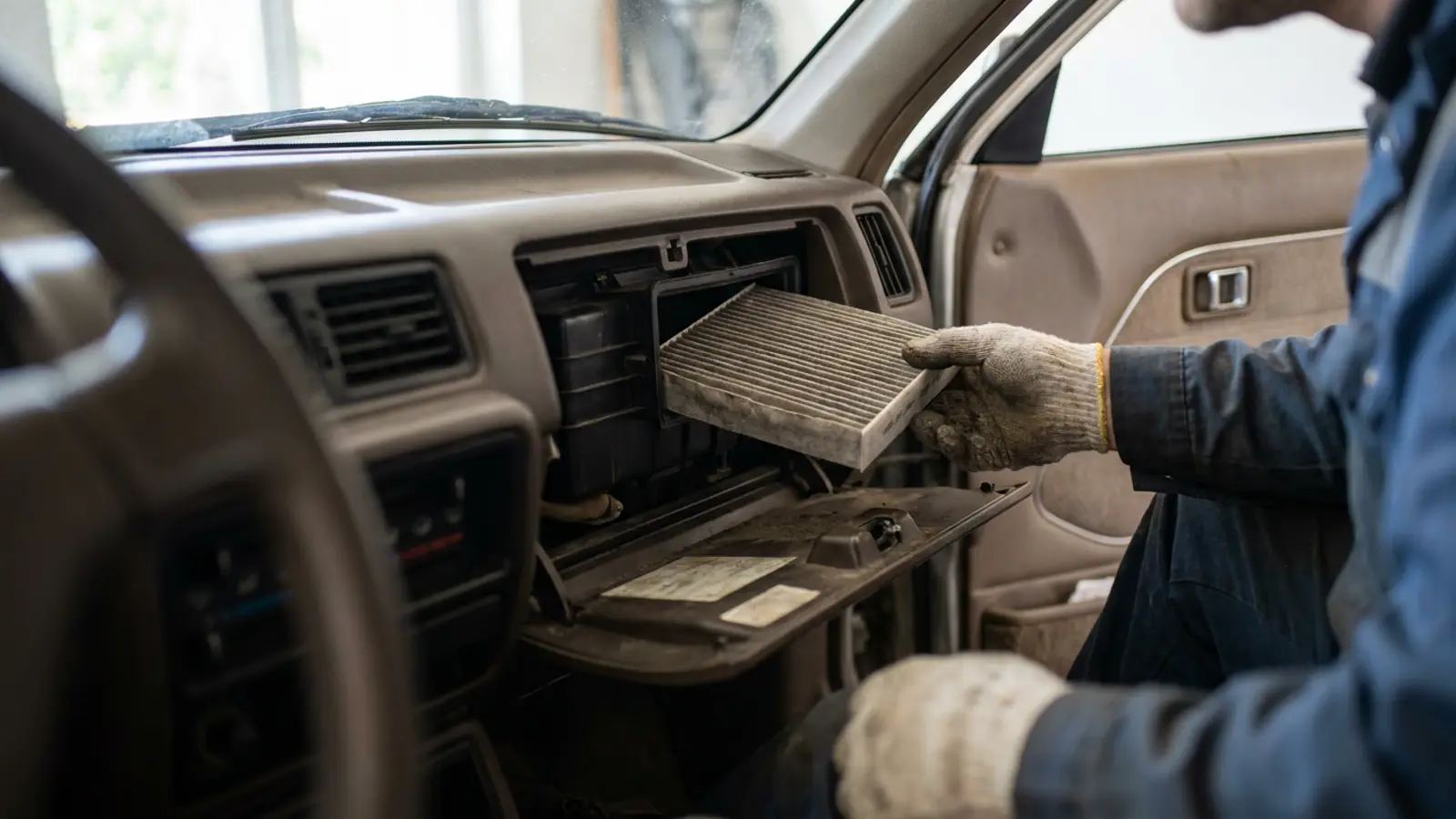
- Locate and inspect the cabin air filter, usually behind the glovebox.
- Listen for a clicking sound behind the dash when changing modes.
- Listen for any blower noise at all when the fan is switched on.
- Check the cowl area outside the windshield for packed leaves.
Stop and get help if you notice
- • Burning smell from the vents.
- • Melted connector or scorched plastic smell at the resistor.
- • Smoke from the dash area.
2-Minute Tests for an AC Not Blowing Air in My Car
Each test isolates one specific cause so you know what you are dealing with before anyone quotes you a repair. Stop immediately if anything feels unsafe.
Fuse box inspection
About 3 minutesTools: Owner's manual, fuse puller
Tests for: Blown fuse
- Turn the engine and ignition off.
- Open the fuse box lid and find the blower or HVAC fuse using the manual diagram.
- Pull the fuse and hold it to the light to check the internal wire.
- Normal result
- The thin wire inside the fuse is intact and unbroken.
- Problem result
- The wire is visibly broken or the fuse body looks scorched.
What it means: A broken fuse cuts power to the blower circuit entirely and must be replaced with the same amperage rating.
Fan speed sweep
About 2 minutesTools: None
Tests for: Failed blower motor resistor or module
- Turn the ignition to accessory or start the engine.
- Cycle the fan switch through every available speed, low to high.
- Note at which speeds you get airflow.
- Normal result
- Airflow increases smoothly with every step of the fan switch.
- Problem result
- Airflow appears only on the single highest setting and nowhere else.
What it means: This pattern is a well-known signature of a failed blower resistor or control module.
Blower sound check
About 1 minuteTools: None
Tests for: Failed blower motor
- Turn the fan to its highest speed.
- Put your ear near the dash vents.
- Listen for any motor sound at all, even without airflow.
- Normal result
- You hear the blower motor spin up even faintly.
- Problem result
- There is complete silence with no motor sound at any speed.
What it means: Silence at every speed with a good fuse points toward a seized or dead blower motor.
Cabin filter inspection
About 5 minutesTools: None, sometimes a screwdriver
Tests for: Clogged cabin air filter
- Locate the cabin air filter cover, usually behind the glovebox.
- Open the cover and slide out the filter.
- Hold it up to a light source and look for how much light passes through.
- Normal result
- Light passes through the filter material evenly.
- Problem result
- The filter is dark, matted, or blocks almost all light.
What it means: A severely clogged filter can reduce airflow at the vents dramatically even with a healthy blower motor.
What Fixing an AC Not Blowing Air in My Car Typically Costs
Cabin air filter
- DIY
- $15-$35
- Professional
- $40-$80
- Typical time
- 10-20 min
Blower fuse replacement
- DIY
- $5-$15
- Professional
- $30-$70
- Typical time
- 10-15 min
Blower motor resistor or control module
- DIY
- $25-$90 parts if accessible
- Professional
- $120-$350
- Typical time
- 0.5-1.5 hrs
Blower motor replacement
- DIY
- Not typically a DIY repair
- Professional
- $200-$550
- Typical time
- 1-3 hrs
Mode door actuator replacement
- DIY
- Not a DIY repair
- Professional
- $220-$600
- Typical time
- 1-4 hrs
| Problem | DIY cost | Professional cost | Typical time |
|---|---|---|---|
| Cabin air filter | $15-$35 | $40-$80 | 10-20 min |
| Blower fuse replacement | $5-$15 | $30-$70 | 10-15 min |
| Blower motor resistor or control module | $25-$90 parts if accessible | $120-$350 | 0.5-1.5 hrs |
| Blower motor replacement | Not typically a DIY repair | $200-$550 | 1-3 hrs |
| Mode door actuator replacement | Not a DIY repair | $220-$600 | 1-4 hrs |
Ranges are national estimates for planning only. Local labor rates, equipment access and parts availability change what you will actually be quoted.
Working Through an AC Not Blowing Air in My Car
Does the fan work on the highest speed only?
Yes: Blower resistor or control module is the likely cause.
No: Continue.
Is there any blower sound at all?
Yes: Air is being moved but blocked or misdirected — check filter and mode doors.
No: Check the fuse, then the blower motor and its wiring.
Do you hear clicking behind the dash?
Yes: A mode door actuator is likely failing.
No: Have the blower circuit tested.
What the technician will check
- Blower motor voltage and current draw.
- Resistor or blower control module testing.
- Connector and wiring inspection for heat damage.
- Cabin filter and blower housing inspection.
- Mode door actuator calibration and HVAC module scan.
Repair considerations
- • Fuses and cabin filters are inexpensive.
- • Blower resistors are typically an affordable part with modest labor.
- • Blower motors and actuators can require significant dash disassembly on some vehicles, which drives labor cost.
What this actually means
The blower motor is what moves air through the vehicle's HVAC box. It is controlled through a resistor or solid-state module that sets fan speed, and its output is directed by mode doors. Any break in that chain stops air at the vents whether or not the compressor is running.
When to Call an Automotive AC Technician About an AC Not Blowing Air in My Car
- The fuse is intact and the blower is silent.
- You smell burning from the vents or dash.
- Airflow works only on some speeds.
- You hear clicking behind the dash.
Preventing an AC Not Blowing Air in My Car From Coming Back
- • Replace the cabin air filter at the recommended interval.
- • Keep the cowl drain area clear of leaves.
- • Address intermittent fan speeds early — resistors often fail progressively.
Worth doing yourself
- • Check and replace the HVAC/blower fuse if the wire inside is broken.
- • Replace a clogged cabin air filter.
- • Clear packed leaves from the cowl area outside the windshield near the fresh-air intake.
- • Confirm the fan switch itself is not stuck or making poor contact.
Do not waste money on
- • Forcing the fan knob repeatedly when there is no sound at all — this rarely helps and can break the switch.
- • Ignoring a burning smell from the vents to keep using the highest fan speed, which can mean a melting resistor connector.
- • Assuming a refrigerant recharge will fix a pure airflow problem — no airflow is not a cooling issue.
Related Problems: AC Not Blowing Air in My Car
- GREEN — Usually ManageableCar ACWhy Is My AC Not Blowing Cold Air in My Car?Read this next if vehicle A/C moves air through the dash vents but the air is not cold — automotive refrigerant, compressor clutch and condenser diagnosis.View answer
- GREEN — Usually ManageableCar ACWhy Is My AC Not Working in My Car?Read this next if broad vehicle A/C failure with no symptom specified — a triage page that classifies airflow, temperature and electrical failures.View answer
- GREEN — Usually ManageableCar ACWhy Is My AC Blowing Hot Air in My Car?Read this next if vehicle vents deliver genuinely hot air, implicating heater core blending and blend door position as much as the refrigeration loop.View answer
- GREEN — Usually ManageableCar ACWhy Is My AC Squealing in My Car?Read this next if high-pitched squeal when the vehicle A/C engages — serpentine belt, tensioner, clutch and compressor bearing diagnosis.View answer
- GREEN — Usually ManageableCar ACWhy Is My AC Not Turning On in My Car?Read this next if pressing the A/C button produces no response at all — control head, fuse, relay and request-signal diagnosis rather than cooling performance.View answer
- GREEN — Usually ManageableCar ACWhy Is My AC Compressor Not Turning On in My Car?Read this next if the vehicle compressor clutch will not engage — low-pressure cutout, clutch coil, relay and control-side electrical diagnosis.View answer
- All Car AC problemsBrowse category
Frequently Asked Questions About an AC Not Blowing Air in My Car
Guidance this page draws on
- vehicle manufacturer service literature — blower circuit fuse ratings and resistor/module wiring diagrams
- automotive A/C service equipment documentation — blower motor current draw and diagnostic procedures