
Why Is My AC Whistling?
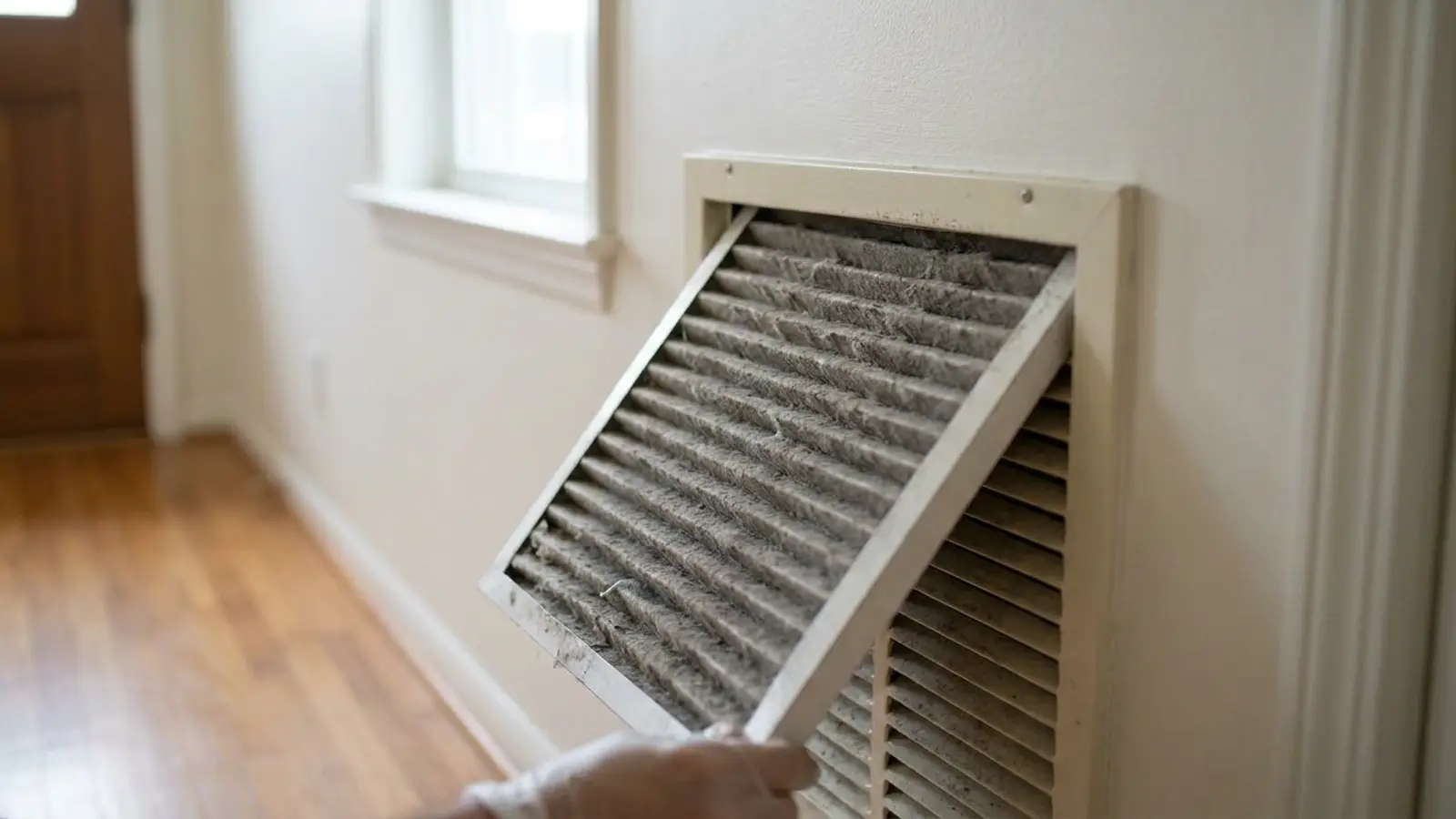
Causes, safe checks and when to call a professional
Expert Answer: AC Whistling
Whistling is an airflow symptom, not a mechanical one. It happens when air is forced through an opening that is too small for the volume moving through it, which raises velocity and produces a tone. The usual causes are a clogged or overly restrictive filter, too many closed registers, an undersized return duct, a gap around the filter frame, or a partially closed damper. Start by replacing the filter with a less restrictive one and opening every register. If the whistle persists, duct static pressure is likely too high and worth measuring.
Check these 3 things first
- 1Replace the filter and confirm it seats without gaps in its track.
- 2Open every supply register in the home before judging the sound.
- 3Note whether the whistle is at the filter/return or at one specific register.
How Serious Is This?
GREEN — this issue's severity level
Usually Manageable(this issue)
Often resolved with basic homeowner checks and routine maintenance.
YELLOW
Inspection Recommended
Worth a professional diagnosis soon to avoid a larger repair.
RED
Potentially Serious
Stop using the system and get professional help right away.
Most Likely Causes of an AC Whistling
1. Restrictive or clogged air filter
High-MERV filters and loaded filters both raise pressure drop dramatically.
2. Too many closed or blocked registers
Reducing outlets forces the same air through fewer openings.
3. Undersized return duct or grille
The single most common design cause of chronic whistling.
4. Gap around the filter or filter door
Air pulled through a narrow gap produces a sharp tone.
5. Partially closed damper
A balancing damper left mostly shut creates a whistle at that branch.
6. Crushed or kinked flex duct
A pinched run acts as an orifice.
7. Blower speed set too high
More airflow through an unchanged duct system means more noise.
Safe Homeowner Checks for an AC Whistling
- Replace the filter, and consider a lower-restriction filter of the correct size.
- Confirm the filter seats fully with no gaps around the frame.
- Open every supply register and clear furniture from returns.
- Locate the whistle: filter cabinet, a specific register, or throughout.
- Check accessible flex duct for kinks or crushed sections.
- Look for dampers in accessible duct that may be partly closed.
Stop and get help if you notice
- • Whistling plus weak airflow at registers.
- • Coil freezing along with the whistle.
- • The filter visibly bowing inward from suction.
2-Minute Tests for an AC Whistling
Each test isolates one specific cause so you know what you are dealing with before anyone quotes you a repair. Stop immediately if anything feels unsafe.
Filter restriction listen test
About 3 minutesTools: Replacement filter
Tests for: Restrictive or clogged air filter
- Listen at the filter cabinet or return grille while running the system with the old filter.
- Swap in a clean, correctly sized filter.
- Run the system again and compare the whistle intensity at the same spot.
- Normal result
- The whistle is noticeably reduced or gone with a clean filter.
- Problem result
- The whistle is unchanged after replacing the filter.
What it means: No change after a filter swap points toward return duct sizing rather than the filter itself.
Register census test
About 5 minutesTools: None
Tests for: Too many closed or blocked registers
- Walk every room and count how many supply registers are open versus closed.
- Open all of them, including ones in unused rooms.
- Run the system for a few minutes and reassess the whistle.
- Normal result
- The whistle diminishes once at least 80% of registers are open.
- Problem result
- The whistle persists even with all registers fully open.
What it means: Persistence with all registers open shifts suspicion toward the return side or duct static pressure.
Return-only whistle isolation
About 3 minutesTools: None
Tests for: Undersized return duct or grille
- Stand at the return grille specifically, separate from any supply register.
- Listen for a sharp tone concentrated only there.
- Compare its intensity to the sound level at supply registers.
- Normal result
- Similar, moderate air sound at return and supply.
- Problem result
- A sharp whistle concentrated heavily at the return, much louder than supplies.
What it means: A return-concentrated whistle is the signature of an undersized return duct or grille.
Branch damper spot-check
About 5 minutesTools: Flashlight
Tests for: Partially closed damper
- Locate any accessible balancing dampers in exposed ductwork.
- Check each handle position relative to the duct run direction.
- Note which register serves a duct with a mostly closed damper and check if that register whistles.
- Normal result
- Dampers are aligned with the duct run (open) and no single register whistles alone.
- Problem result
- A damper is turned mostly crosswise and its register whistles distinctly.
What it means: A near-closed damper on one branch causes a whistle localized to that single register.
What Fixing an AC Whistling Typically Costs
Low-restriction filter swap
- DIY
- $15-$40
- Professional
- N/A
- Typical time
- 10 minutes
Damper adjustment
- DIY
- $0
- Professional
- $80-$150
- Typical time
- 20 minutes
Return grille/duct enlargement
- DIY
- Not a DIY repair
- Professional
- $400-$1,500
- Typical time
- 4-8 hours
Static pressure measurement/diagnosis
- DIY
- Not a DIY repair
- Professional
- $100-$200
- Typical time
- 1 hour
Crushed flex duct repair
- DIY
- Not a DIY repair
- Professional
- $150-$400
- Typical time
- 1-2 hours
| Problem | DIY cost | Professional cost | Typical time |
|---|---|---|---|
| Low-restriction filter swap | $15-$40 | N/A | 10 minutes |
| Damper adjustment | $0 | $80-$150 | 20 minutes |
| Return grille/duct enlargement | Not a DIY repair | $400-$1,500 | 4-8 hours |
| Static pressure measurement/diagnosis | Not a DIY repair | $100-$200 | 1 hour |
| Crushed flex duct repair | Not a DIY repair | $150-$400 | 1-2 hours |
Ranges are national estimates for planning only. Local labor rates, equipment access and parts availability change what you will actually be quoted.
Working Through an AC Whistling
Is the whistle at the filter or return grille?
Yes: Filter restriction or undersized return — the most common case.
No: Continue.
Is it at one specific register?
Yes: Check that register's damper and duct for restriction.
No: Continue.
Does replacing the filter and opening registers reduce it?
Yes: Restriction confirmed. Keep filters current and registers open.
No: Have duct static pressure measured.
What the technician will check
- Total external static pressure measurement.
- Return duct and grille sizing.
- Filter pressure drop assessment.
- Damper positions and duct condition.
- Blower speed configuration.
Repair considerations
- • Filter changes and register adjustments are free or nearly so.
- • Adding return air capacity is duct work but often transforms both noise and performance.
- • Blower speed adjustment is typically part of a service visit.
What this actually means
Every duct system has a static pressure the equipment was designed for. Push more air through less opening and the pressure rises, velocity climbs, and the system whistles. That same high pressure also reduces airflow, hurts capacity and stresses the blower — so the noise is a useful early warning rather than a cosmetic annoyance.
When to Call an HVAC Professional About an AC Whistling
- Whistling persists after filter and register changes.
- Airflow is weak throughout the house.
- The coil freezes.
- The filter bows inward under suction.
Preventing an AC Whistling From Coming Back
- • Use the filter type and size the system was designed for.
- • Keep at least 80% of registers open.
- • Have static pressure checked during maintenance.
Worth doing yourself
- • Use the correctly sized, lower-restriction filter recommended for the system.
- • Keep at least 80% of supply registers open at all times.
- • Check accessible flex duct runs for kinks and straighten gentle bends.
- • Adjust any accessible balancing damper that sits mostly closed.
Do not waste money on
- • Do not close registers in unused rooms to try to redirect air; it raises pressure and worsens whistling.
- • Do not upgrade to the highest available MERV filter without checking its pressure drop rating.
Related Problems: AC Whistling
- YELLOW — Inspection RecommendedAC NoisesWhy Is My AC Making a Hissing Noise?Read this next if specifically a hissing sound — refrigerant escape, valve noise and duct leakage are the differential, with a real leak risk to rule out.View answer
- YELLOW — Inspection RecommendedAC Not CoolingWhy Is My AC Not Blowing Air?Read this next if no air movement at all at the registers — an airflow and blower problem rather than a temperature problem.View answer
- GREEN — Usually ManageableAC NoisesWhy Is My AC So Loud?Read this next if overall sound level has increased across the whole system — a volume complaint rather than a specific identifiable sound.View answer
- GREEN — Usually ManageableAC NoisesWhy Is My AC Making Noise?Read this next if sound type not yet identified — the page must act as a sound directory that maps each noise to its likely cause.View answer
- YELLOW — Inspection RecommendedAC Water LeaksWhy Is My AC Vent Dripping Water?Read this next if water appearing at supply registers and grilles — a duct insulation, humidity and airflow issue rather than a condensate drain issue.View answer
- YELLOW — Inspection RecommendedAC FreezingWhy Is My AC Freezing Up?Read this next if ice is actively forming during operation and the visitor wants the mechanism plus the immediate corrective action.View answer
- All AC Noises problemsBrowse category
Frequently Asked Questions About an AC Whistling
Guidance this page draws on
- ACCA — Manual D duct design principles referenced for return sizing and static pressure.
- ENERGY STAR — Filter selection and airflow guidance for residential systems.