
Why Is My AC Vent Dripping Water?
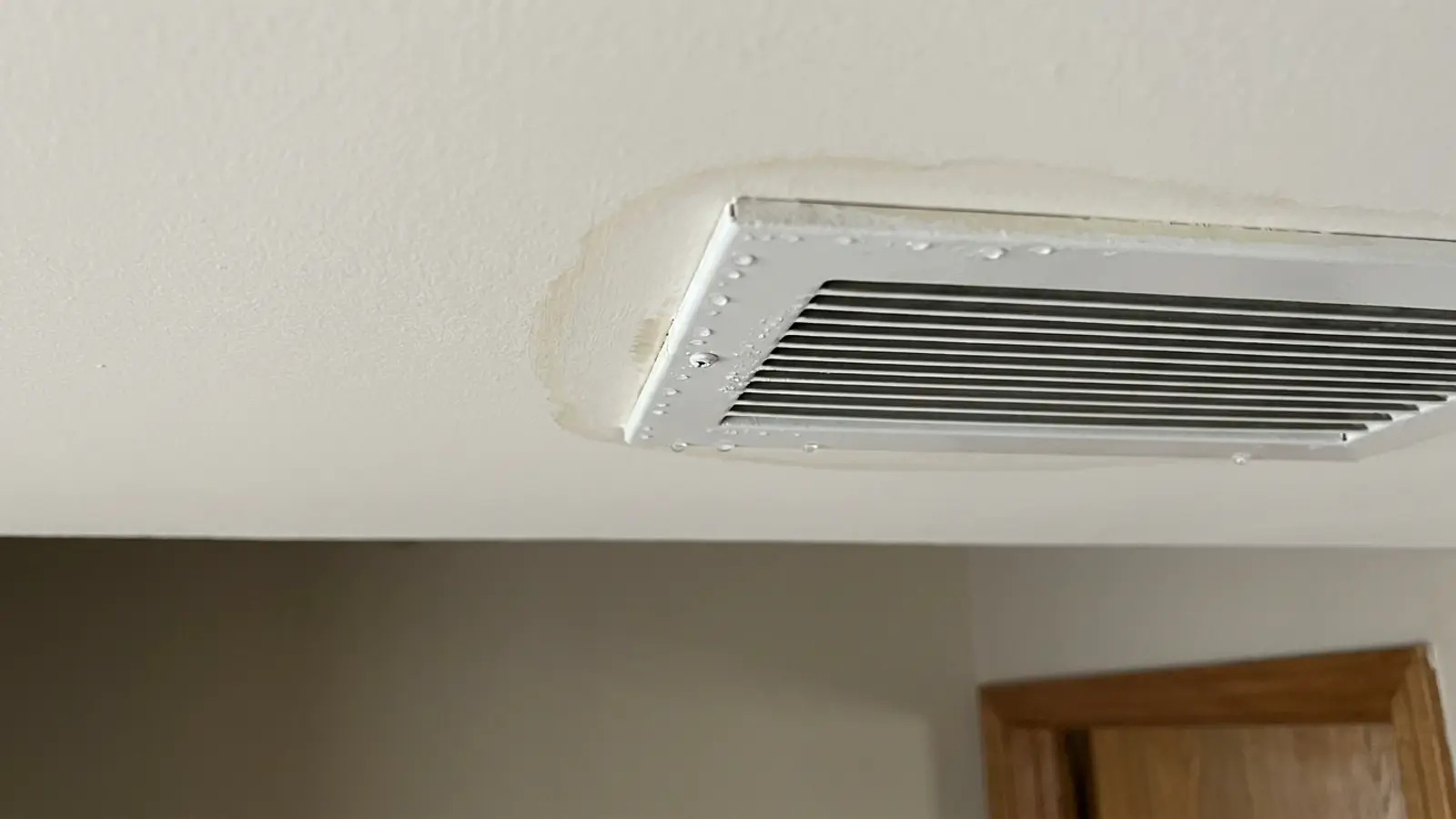
Causes, safe checks and when to call a professional
Expert Answer: AC Vent Dripping Water
Water dripping from a supply register is usually condensation forming on cold metal, not condensate escaping the drain pan. Cold duct or grille surfaces sitting in humid air — an attic, a crawlspace, or a humid room — collect moisture the same way a cold glass does. The causes are missing or compressed duct insulation, humid air leaking into the duct chase, very low supply air temperature from restricted airflow, or a duct running through an unconditioned space without a vapor barrier. Occasionally water blown off the coil travels through the duct and exits at the nearest register.
Check these 3 things first
- 1Confirm the water is coming from the register or duct, not a ceiling leak above it.
- 2Check nearby duct insulation for gaps, compression, or moisture.
- 3Note your indoor humidity level, especially if it feels muggy indoors.
How Serious Is This?
GREEN
Usually Manageable
Often resolved with basic homeowner checks and routine maintenance.
YELLOW — this issue's severity level
Inspection Recommended(this issue)
Worth a professional diagnosis soon to avoid a larger repair.
RED
Potentially Serious
Stop using the system and get professional help right away.
Most Likely Causes of an AC Vent Dripping Water
1. Missing, compressed or wet duct insulation
Insulation keeps duct surfaces above the dew point. Where it is missing or crushed, the metal sweats.
2. Humid air reaching the duct exterior
Attic and crawlspace air is far more humid than conditioned air, so unsealed vapor barriers allow condensation directly on the metal.
3. Very cold supply air from restricted airflow
Low airflow pushes supply temperature down, making duct and register surfaces colder and more prone to sweating.
4. High indoor humidity
Bathrooms, kitchens and homes with infiltration problems can push room dew point above the register temperature.
5. Water blown off the evaporator coil
Excessive airflow or a poorly fitted coil can carry droplets into the supply duct, which then exit at a register.
6. Uninsulated register boot
Even with insulated duct, a bare sheet-metal boot at the ceiling is a classic condensation point.
Safe Homeowner Checks for an AC Vent Dripping Water
- Note which registers drip and whether they are on attic-fed runs.
- Check indoor humidity — over 60% makes vent sweating far more likely.
- Look at accessible duct above the affected register for missing or wet insulation.
- Replace a dirty filter and open closed registers to raise airflow.
- Run bathroom and kitchen exhaust fans to reduce indoor moisture.
- Check whether the drip only happens during long cooling cycles or humid weather.
Stop and get help if you notice
- • Ceiling staining spreading around the register.
- • Mold growth at the grille or on the ceiling.
- • Insulation that is saturated and sagging.
2-Minute Tests for an AC Vent Dripping Water
Each test isolates one specific cause so you know what you are dealing with before anyone quotes you a repair. Stop immediately if anything feels unsafe.
Inspect accessible duct insulation
About 15 minutesTools: Flashlight
Tests for: Missing, compressed or wet duct insulation
- Access the nearest visible section of ductwork, such as in an attic or basement.
- Look for insulation that is thin, torn, or missing at seams.
- Feel the insulation for dampness.
- Check whether the bare metal beneath feels cold and wet.
- Normal result
- Insulation is intact, dry, and fully covers the duct surface.
- Problem result
- Insulation is gaps, wet, or missing over cold duct sections.
What it means: Exposed cold duct metal in humid air sweats and drips at the nearest low point, often a register.
Check the space around the duct for humidity sources
About 10 minutesTools: None
Tests for: Humid air reaching the duct exterior
- Note whether the dripping duct passes through an unconditioned attic, crawlspace, or garage.
- Check for obvious humidity sources nearby, like a bath fan venting into the attic.
- Feel the air near the duct for mugginess.
- Check whether the dripping worsens on humid days.
- Normal result
- The space is dry and dripping does not track with outdoor humidity.
- Problem result
- The space is noticeably humid and drips worsen in muggy weather.
What it means: High ambient humidity around a cold duct is what drives sweating at that spot.
Check supply air temperature and filter condition
About 10 minutesTools: Thermometer (optional)
Tests for: Very cold supply air from restricted airflow
- Check the filter for heavy dust loading.
- Feel or measure the air coming from the dripping register.
- Compare it to air from a nearby register that is not dripping.
- Replace the filter if it is dirty and observe over the next day.
- Normal result
- Supply air feels typically cool, similar across registers.
- Problem result
- The dripping register's air feels unusually cold compared to others.
What it means: Overly cold supply air from restricted airflow makes that duct section sweat more than the rest.
Inspect the register boot itself
About 10 minutesTools: Flashlight, screwdriver
Tests for: Uninsulated register boot
- Remove the register grille with a screwdriver.
- Shine a light down into the metal boot connecting the duct to the ceiling or floor.
- Check whether the boot is insulated or bare sheet metal.
- Feel the boot for cold, damp metal.
- Normal result
- The boot is insulated or dry to the touch.
- Problem result
- The boot is bare metal and cold or damp.
What it means: An uninsulated boot in a humid ceiling or floor cavity condenses and drips directly at the vent.
What Fixing an AC Vent Dripping Water Typically Costs
Duct insulation wrap/repair
- DIY
- $20-$60
- Professional
- $150-$400
- Typical time
- 1-2 hours
Register boot insulation
- DIY
- $10-$25
- Professional
- $75-$150
- Typical time
- 30-60 minutes
Filter replacement/airflow fix
- DIY
- $10-$30
- Professional
- $100-$250
- Typical time
- 30 minutes
Whole-home dehumidification add-on
- DIY
- Not a DIY repair
- Professional
- $1,200-$2,800
- Typical time
- 1 day
Bath/attic ventilation correction
- DIY
- $50-$150
- Professional
- $200-$600
- Typical time
- 2-4 hours
| Problem | DIY cost | Professional cost | Typical time |
|---|---|---|---|
| Duct insulation wrap/repair | $20-$60 | $150-$400 | 1-2 hours |
| Register boot insulation | $10-$25 | $75-$150 | 30-60 minutes |
| Filter replacement/airflow fix | $10-$30 | $100-$250 | 30 minutes |
| Whole-home dehumidification add-on | Not a DIY repair | $1,200-$2,800 | 1 day |
| Bath/attic ventilation correction | $50-$150 | $200-$600 | 2-4 hours |
Ranges are national estimates for planning only. Local labor rates, equipment access and parts availability change what you will actually be quoted.
Working Through an AC Vent Dripping Water
Is the affected duct in an attic or crawlspace?
Yes: Insulation and vapor barrier are the leading suspects.
No: Continue.
Is indoor humidity above about 60%?
Yes: Address humidity sources and dehumidification alongside any duct work.
No: Continue.
Is airflow at that register weak?
Yes: Low airflow drops supply temperature and worsens condensation — check filter and duct restrictions.
No: Have the duct insulation and boot sealing inspected.
What the technician will check
- Duct insulation and vapor barrier inspection.
- Register boot sealing.
- Airflow and supply temperature measurement.
- Indoor humidity assessment and dehumidification options.
- Coil condition and blow-off evaluation.
Repair considerations
- • Insulating and sealing a few register boots is inexpensive; re-insulating an entire duct system is a larger project.
- • Whole-home dehumidification is a separate equipment decision.
- • Ceiling repair is a separate trade.
What this actually means
This symptom is about surface temperature versus dew point, not drainage. Anywhere duct metal falls below the dew point of the surrounding air, water forms. That is why vent dripping tends to be worst during humid weather, in rooms with high humidity, and at registers fed by attic ductwork.
When to Call an HVAC Professional About an AC Vent Dripping Water
- Ceilings are staining or mold is appearing.
- Duct insulation is saturated or missing over long runs.
- Humidity stays high despite normal AC operation.
- You suspect water is being blown off the coil.
Preventing an AC Vent Dripping Water From Coming Back
- • Maintain intact duct insulation and vapor barriers.
- • Keep indoor relative humidity in the 45–55% range.
- • Maintain good airflow so supply temperature does not run abnormally low.
- • Seal attic bypasses that let humid air reach ductwork.
Worth doing yourself
- • Wrap accessible bare duct sections with rated duct insulation.
- • Replace a dirty filter to bring supply air temperature back to normal.
- • Seal gaps around register boots where humid air infiltrates.
- • Run a bathroom exhaust fan properly vented outside, not into the attic.
Do not waste money on
- • Snaking or flushing the drain line for this symptom — the drain is usually not involved.
- • Sealing a dripping register with tape without addressing the humidity or insulation cause.
Related Problems: AC Vent Dripping Water
- YELLOW — Inspection RecommendedAC Water LeaksWhy Is My AC Dripping Water?Read this next if active, ongoing dripping observed in real time — emphasis on the drip location and whether that specific drip is normal.View answer
- YELLOW — Inspection RecommendedAC Water LeaksWhy Is My AC Leaking Water Inside?Read this next if water is appearing indoors and the visitor is concerned about interior damage — emphasis on containment and stopping the water.View answer
- YELLOW — Inspection RecommendedAC Water LeaksWhy Is My AC Leaking Water?Read this next if broad water-leak diagnosis with no location specified yet — the visitor needs to identify the source before anything else.View answer
- GREEN — Usually ManageableAC Operation ProblemsWhy Is My AC Not Keeping Up?Read this next if system cools but loses ground against peak load — the house drifts above setpoint during the hottest hours and recovers at night.View answer
- GREEN — Usually ManageableAC NoisesWhy Is My AC Whistling?Read this next if high-pitched airflow noise driven by duct static pressure and restriction — an air distribution problem rather than a mechanical failure.View answer
- YELLOW — Inspection RecommendedAC Water LeaksWhy Is My AC Unit Leaking Water?Read this next if water is visibly originating at the equipment cabinet — indoor air handler or outdoor condenser — rather than appearing elsewhere in the home.View answer
- All AC Water Leaks problemsBrowse category
Frequently Asked Questions About an AC Vent Dripping Water
Guidance this page draws on
- U.S. Department of Energy — Duct insulation and sealing recommendations for humid climates.
- ENERGY STAR — Guidance on duct condensation prevention in conditioned and unconditioned spaces.