
Why Is My AC Not Cold?
Causes, safe checks and when to call a professional
Expert Answer: AC Not Cold
The short version: your AC is not cold because either it is not actually running the cooling cycle, or it is running but cannot move heat. A two-minute test tells you which. Set the thermostat to COOL and the fan to AUTO, wait five minutes, then go outside. If the outdoor unit is running and the vents still are not cold, it is a refrigeration or airflow problem needing service. If the outdoor unit is not running, it is an electrical or control problem — also needing service, but a different repair.
Check these 3 things first
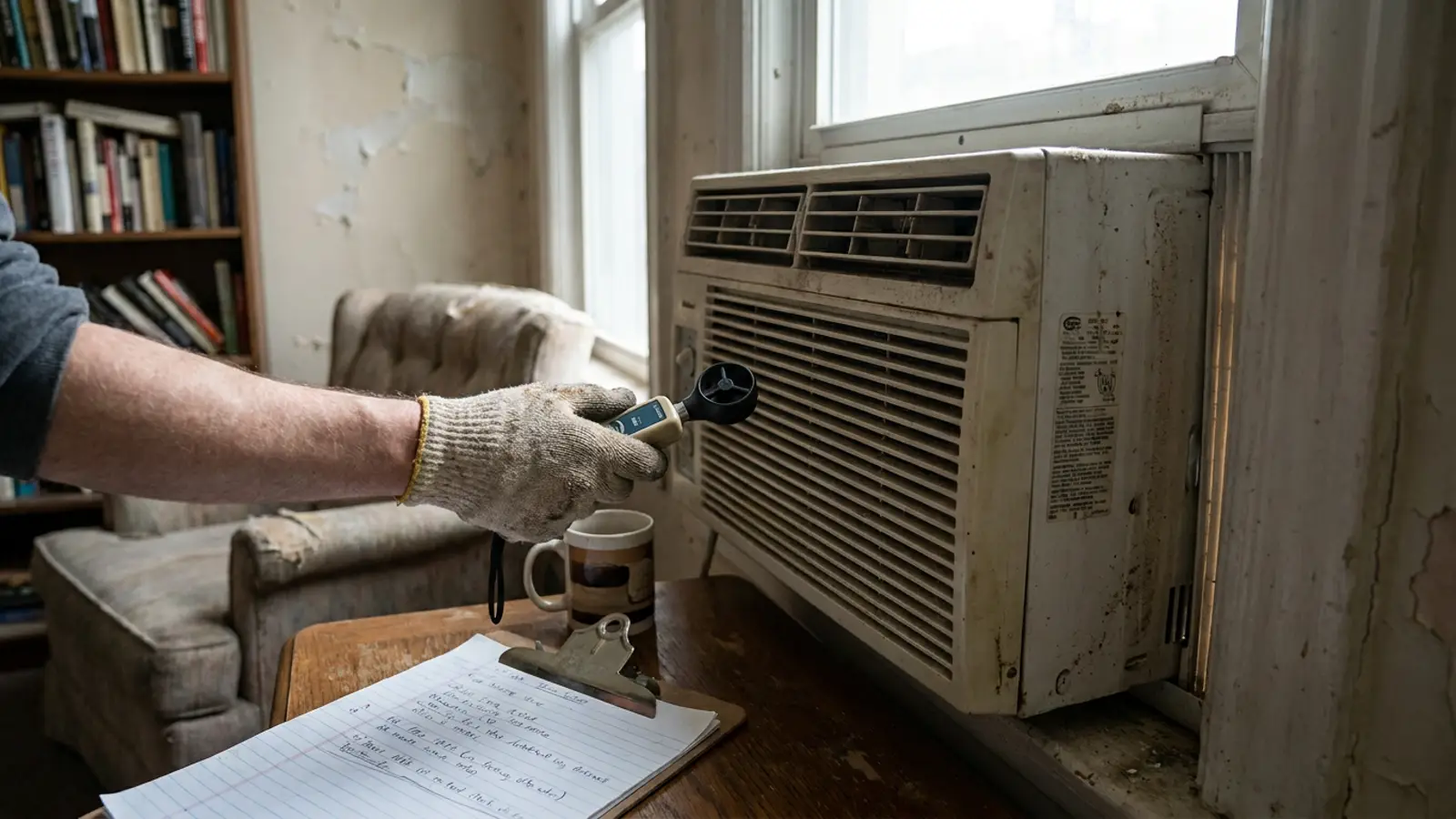
- 1Measure vent temperature with a thermometer rather than relying on feel.
- 2Check indoor humidity, since high humidity makes air feel warmer than its actual temperature.
- 3Confirm the thermostat setpoint is meaningfully below the current room reading.
How Serious Is This?
GREEN
Usually Manageable
Often resolved with basic homeowner checks and routine maintenance.
YELLOW — this issue's severity level
Inspection Recommended(this issue)
Worth a professional diagnosis soon to avoid a larger repair.
RED
Potentially Serious
Stop using the system and get professional help right away.
Most Likely Causes of an AC Not Cold
1. Thermostat mode or fan setting
COOL mode with AUTO fan is required. Anything else produces uncooled air.
2. Filter restriction
A loaded filter is the most common homeowner-fixable cause of weak, uncold air.
3. Compressor not running
No compressor, no cold. Electrical faults and lockouts are the usual reasons.
4. Low refrigerant charge
The system can only remove heat if it has the right amount of refrigerant circulating.
5. Dirty coils
Fouled indoor or outdoor coils cut heat transfer on either side of the cycle.
Safe Homeowner Checks for an AC Not Cold
- Thermostat: COOL mode, fan AUTO, setpoint below room temperature.
- Filter: replace if dirty.
- Outdoor unit: confirm it runs when the thermostat calls.
- Registers: confirm they are open and unobstructed.
- Breaker: confirm both indoor and outdoor breakers are on.
Stop and get help if you notice
- • Ice on the copper lines.
- • Repeated breaker trips.
- • Burning smell during operation.
2-Minute Tests for an AC Not Cold
Each test isolates one specific cause so you know what you are dealing with before anyone quotes you a repair. Stop immediately if anything feels unsafe.
Perceived versus measured temperature check
About 5 minutesTools: Basic thermometer
Tests for: Thermostat mode or fan setting
- Hold a thermometer at a supply register for one minute.
- Hold the same thermometer at a return grille for one minute.
- Subtract the two readings.
- Normal result
- Supply air reads roughly 16-22°F colder than return air.
- Problem result
- The difference is much smaller than that, even though the air feels somewhat cool.
What it means: A small measured split means the system is not cooling well even if the air feels acceptable subjectively.
Filter check
About 2 minutesTools: None
Tests for: Filter restriction
- Remove and inspect the filter.
- Replace it if visibly loaded with dust.
- Normal result
- Filter is clean and allows light through.
- Problem result
- Filter is dark and clogged.
What it means: A restricted filter reduces the temperature split even when the compressor is working normally.
Outdoor unit run confirmation
About 3 minutesTools: None
Tests for: Compressor not running
- Go outside during a cooling call.
- Confirm the fan spins and a steady hum is present.
- Normal result
- Unit runs continuously without cycling off quickly.
- Problem result
- Unit is off, or clicks on and off within seconds.
What it means: The compressor is not running long enough or at all, so no real cooling is occurring.
Comfort versus humidity distinction
About 5 minutesTools: None (optional indoor hygrometer)
Tests for: Low refrigerant charge
- Note if the house feels sticky or clammy rather than simply warm.
- Check an indoor humidity reading if you have one.
- Compare with how the house has felt in past cooling seasons.
- Normal result
- Indoor humidity sits in a comfortable range and the house has felt this way before.
- Problem result
- Humidity feels notably higher than usual alongside weak cooling.
What it means: Low refrigerant charge reduces both temperature drop and moisture removal, making the space feel warm and humid together.
What Fixing an AC Not Cold Typically Costs
Filter replacement
- DIY
- $15-$30
- Professional
- $40-$80
- Typical time
- 10 minutes
Capacitor/contactor repair
- DIY
- Not a DIY repair
- Professional
- $150-$400
- Typical time
- 1 hour
Refrigerant leak diagnosis and repair
- DIY
- Not a DIY repair
- Professional
- $300-$1,800+
- Typical time
- 2-6 hours
Coil cleaning
- DIY
- $0 (hose rinse)
- Professional
- $100-$250
- Typical time
- 30-60 minutes
| Problem | DIY cost | Professional cost | Typical time |
|---|---|---|---|
| Filter replacement | $15-$30 | $40-$80 | 10 minutes |
| Capacitor/contactor repair | Not a DIY repair | $150-$400 | 1 hour |
| Refrigerant leak diagnosis and repair | Not a DIY repair | $300-$1,800+ | 2-6 hours |
| Coil cleaning | $0 (hose rinse) | $100-$250 | 30-60 minutes |
Ranges are national estimates for planning only. Local labor rates, equipment access and parts availability change what you will actually be quoted.
Working Through an AC Not Cold
Does the outdoor unit run when you lower the setpoint?
Yes: Refrigeration or airflow problem — schedule diagnosis.
No: Electrical or control problem — check breakers, then schedule service.
Is the filter clean?
Yes: Move on to the refrigeration side.
No: Replace it and retest for an hour.
What the technician will check
- Temperature split measurement.
- Refrigerant charge verification.
- Compressor electrical testing.
- Coil inspection.
What this actually means
"Not cold" describes temperature, not airflow. Any time the system runs without producing cold, the refrigeration cycle is the suspect: the compressor, the charge, or the coils. Settings and filters are the two homeowner-fixable exceptions worth ruling out first.
When to Call an HVAC Professional About an AC Not Cold
- Settings and filter are ruled out and the air is still not cold.
- The outdoor unit does not start.
- Ice appears anywhere on the system.
Preventing an AC Not Cold From Coming Back
- • Change filters regularly.
- • Book annual maintenance.
- • Keep the outdoor unit clean.
Worth doing yourself
- • Measure vent and return temperatures with a simple thermometer instead of guessing by feel.
- • Replace the filter.
- • Track indoor humidity to separate a comfort problem from a temperature problem.
- • Confirm the setpoint is at least 3°F below room temperature before judging performance.
Related Problems: AC Not Cold
- YELLOW — Inspection RecommendedAC Not CoolingWhy Is My AC Not Blowing Cold?Read this next if quick check of the vent temperature itself — visitor is standing at a register right now wanting the fastest first moves.View answer
- YELLOW — Inspection RecommendedAC Not CoolingWhy Is My AC Not Cooling?Read this next if general residential AC cooling failure with no specific symptom named yet.View answer
- YELLOW — Inspection RecommendedAC Not CoolingWhy Is My AC Not Blowing Cold Air?Read this next if air is moving from the supply registers but it is not noticeably cold at the vent.View answer
- YELLOW — Inspection RecommendedAC Not CoolingWhy Is My AC Blowing Warm Air?Read this next if air is warm rather than hot — a degraded-but-running cooling cycle, often intermittent or worsening over time.View answer
- YELLOW — Inspection RecommendedAC Not CoolingWhy Is My AC Hot?Read this next if the equipment itself feels hot to the touch or the visitor is describing a hot unit rather than hot vent air.View answer
- YELLOW — Inspection RecommendedAC Won't StartWhy Is My AC Not Working?Read this next if broadest possible failure phrasing — visitor has not characterized the symptom, so the page must triage before it diagnoses.View answer
- All AC Not Cooling problemsBrowse category
Frequently Asked Questions About an AC Not Cold
Guidance this page draws on
- ASHRAE — Comfort perception and humidity's role in perceived temperature.
- ENERGY STAR — Practical vent temperature and filter guidance.