
Why Is My AC Not Blowing Cold Air?
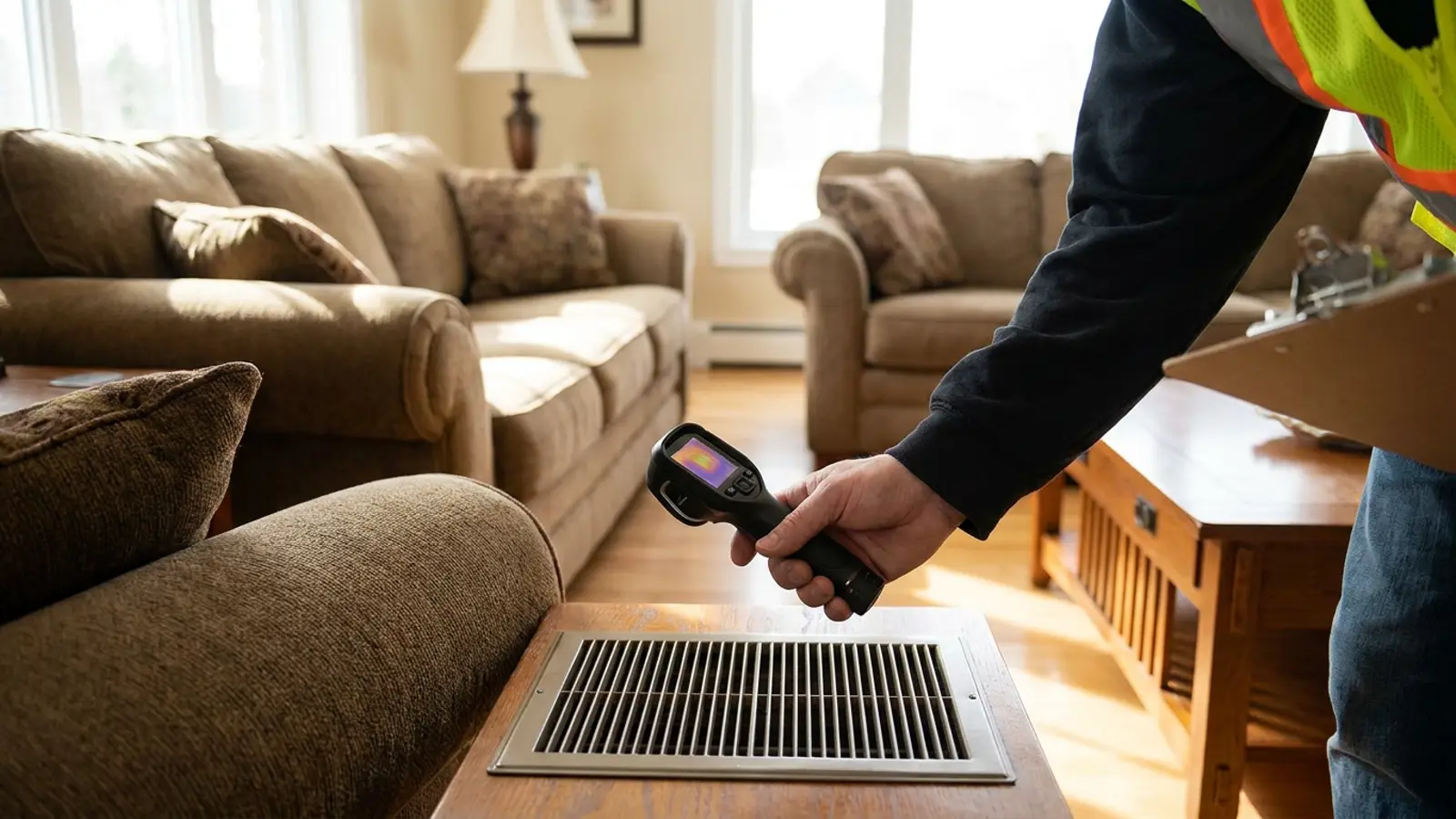
Causes, safe checks and when to call a professional
Expert Answer: AC Not Blowing Cold Air
If your vents are moving air but the air is not cold, the cooling side of the system is either not running or not able to absorb heat. The three explanations that account for most cases are a severely restricted air filter, an outdoor condenser that is not running or is caked with debris, and a refrigerant charge problem caused by a leak. Start by confirming the thermostat is set to COOL with a temperature below room temperature, then check the filter and confirm the outdoor unit is spinning. If the outdoor unit is silent or the air is only slightly cool after 15 minutes, plan on a technician.
Check these 3 things first
- 1Feel the register nearest the air handler versus the farthest register.
- 2Confirm the thermostat mode is COOL and the fan is set to AUTO.
- 3Look at the outdoor unit and see if the fan blade is spinning.
How Serious Is This?
GREEN
Usually Manageable
Often resolved with basic homeowner checks and routine maintenance.
YELLOW — this issue's severity level
Inspection Recommended(this issue)
Worth a professional diagnosis soon to avoid a larger repair.
RED
Potentially Serious
Stop using the system and get professional help right away.
Most Likely Causes of an AC Not Blowing Cold Air
1. Thermostat is not actually calling for cooling
A thermostat left on FAN ON circulates room-temperature air continuously. Setpoint above room temperature, a stuck schedule, or dead batteries produce the same symptom.
2. Clogged air filter
A loaded filter starves the evaporator coil. Less air across the coil means less heat removed, and the air that does come out feels weak and lukewarm.
3. Outdoor condenser unit not running
If the outdoor fan and compressor are off — tripped breaker, pulled disconnect, failed capacitor or contactor — the indoor blower still runs and delivers uncooled air.
4. Dirty condenser coil
Grass clippings, cottonwood and dust blanket the outdoor coil so the system cannot reject heat outside. Cooling capacity drops sharply on hot afternoons.
5. Low refrigerant from a leak
Refrigerant is not consumed. Low charge means a leak somewhere in the circuit. Capacity falls off, and severe undercharge can ice the coil or shut the system down on a pressure switch.
6. Frozen evaporator coil
Ice on the indoor coil blocks airflow entirely. Airflow gets weaker and weaker until nothing but faintly cool air reaches the registers.
7. Failed compressor
If the outdoor fan spins but the compressor does not, the system circulates air and outdoor air but never moves heat. Usually accompanied by a hum or repeated clicking.
Safe Homeowner Checks for an AC Not Blowing Cold Air
- Confirm the thermostat is set to COOL and the setpoint is at least 3°F below the current room temperature.
- Switch the fan from ON to AUTO — constant fan is a common cause of lukewarm vent air.
- Replace the thermostat batteries if it has them.
- Pull the air filter and hold it to a light. If light does not pass through, replace it.
- Go outside and confirm the condenser fan is spinning and the unit is humming.
- Clear leaves, mulch and shrubs at least two feet back from the outdoor unit.
- Check the breaker panel for a tripped AC or air handler breaker (reset once only).
- Compare airflow at a register near the air handler with one at the far end of the house.
Stop and get help if you notice
- • A breaker that trips again immediately after being reset.
- • Burning or hot electrical smell from the indoor or outdoor unit.
- • Ice visible on the copper line set or indoor coil.
2-Minute Tests for an AC Not Blowing Cold Air
Each test isolates one specific cause so you know what you are dealing with before anyone quotes you a repair. Stop immediately if anything feels unsafe.
Verify a real cooling call
About 3 minutesTools: None
Tests for: Thermostat is not actually calling for cooling
- Read the thermostat mode indicator.
- Switch fan from ON to AUTO.
- Lower the setpoint 5°F below room temperature.
- Wait 2 minutes and listen for the outdoor unit to start.
- Normal result
- The outdoor unit starts within a minute and the fan icon shows cooling active.
- Problem result
- Nothing starts even after lowering the setpoint and switching fan modes.
What it means: A dead thermostat, dead batteries, or bad wiring is preventing a cooling call from reaching the equipment.
Filter light test
About 2 minutesTools: None
Tests for: Clogged air filter
- Remove the return air filter.
- Hold it up to a bright light.
- Check if light passes through evenly.
- Normal result
- Light passes through the filter material clearly.
- Problem result
- The filter looks gray or solid and little or no light passes through.
What it means: A clogged filter is starving the coil of airflow, which weakens the cold air reaching the vents.
Outdoor unit visual check
About 3 minutesTools: None
Tests for: Outdoor condenser unit not running
- Walk to the outdoor unit while the system calls for cooling.
- Look for the fan blade spinning on top.
- Listen for a steady hum.
- Check the disconnect box is fully seated.
- Normal result
- The fan spins steadily and the unit hums without clicking.
- Problem result
- The fan is still, or you hear clicking or humming with no fan movement.
What it means: The outdoor unit is not running, so the indoor blower is only circulating uncooled air.
Coil and line-set ice check
About 5 minutesTools: Flashlight
Tests for: Frozen evaporator coil
- Turn cooling off but leave the fan running.
- Open the air handler access panel if easily reachable.
- Shine a light on the coil and the copper suction line.
- Note any frost or ice buildup.
- Normal result
- The coil and lines are dry and free of frost.
- Problem result
- You see white frost or solid ice on the coil fins or copper line.
What it means: Ice is blocking airflow, which is why the vents feel weak instead of cold.
What Fixing an AC Not Blowing Cold Air Typically Costs
Filter replacement
- DIY
- $15-$30
- Professional
- $40-$80
- Typical time
- 10 minutes
Capacitor or contactor replacement
- DIY
- Not recommended
- Professional
- $150-$400
- Typical time
- 1 hour
Condenser coil cleaning
- DIY
- $0 (hose rinse)
- Professional
- $100-$250
- Typical time
- 30-60 minutes
Refrigerant leak repair and recharge
- DIY
- Not a DIY repair
- Professional
- $300-$1,800+
- Typical time
- 2-6 hours
Compressor replacement
- DIY
- Not a DIY repair
- Professional
- $1,500-$3,000+
- Typical time
- Half day
| Problem | DIY cost | Professional cost | Typical time |
|---|---|---|---|
| Filter replacement | $15-$30 | $40-$80 | 10 minutes |
| Capacitor or contactor replacement | Not recommended | $150-$400 | 1 hour |
| Condenser coil cleaning | $0 (hose rinse) | $100-$250 | 30-60 minutes |
| Refrigerant leak repair and recharge | Not a DIY repair | $300-$1,800+ | 2-6 hours |
| Compressor replacement | Not a DIY repair | $1,500-$3,000+ | Half day |
Ranges are national estimates for planning only. Local labor rates, equipment access and parts availability change what you will actually be quoted.
Working Through an AC Not Blowing Cold Air
Is air actually coming from the supply registers?
Yes: The blower is running — focus on the refrigeration side and the outdoor unit.
No: This is an airflow or blower problem, not a cooling problem. Check the filter, breaker and blower.
Is the outdoor condenser unit running (fan spinning, compressor humming)?
Yes: Cooling is being attempted. Suspect airflow restriction, dirty coils or refrigerant charge.
No: Suspect electrical supply, capacitor, contactor or a safety lockout. This needs a technician.
Is the air filter clean and is airflow strong at the registers?
Yes: Move on to condenser cleanliness and refrigerant charge.
No: Replace the filter and open closed registers, then give the system an hour to recover.
Do you see frost or ice on the indoor coil or the copper suction line?
Yes: Turn cooling off, leave the fan on to thaw, and schedule service — icing points to airflow or charge.
No: If air is still not cold after the basics, have the refrigerant circuit measured professionally.
What the technician will check
- Measures supply and return air temperature split across the indoor coil.
- Reads suction and liquid pressures and calculates superheat and subcooling.
- Tests the run capacitor and contactor at the outdoor unit.
- Checks static pressure and blower performance for hidden airflow restrictions.
- Leak-searches the coil, line set and service valves if charge is low.
- Verifies thermostat wiring and the cooling call reaching the equipment.
Repair considerations
- • A capacitor or contactor replacement is a small, common repair.
- • Refrigerant leak repairs vary enormously depending on whether the leak is at an accessible joint or inside the evaporator coil.
- • Systems using R-22 are costly to recharge; on an older unit that shifts the math toward replacement.
- • A failed compressor on a system past roughly 12–15 years is usually a replacement conversation rather than a repair.
What this actually means
Airflow and cooling are two separate jobs. The blower moves air; the refrigeration circuit removes heat from it. When you feel air but not cold air, the blower is doing its job and the refrigeration circuit is not — or it is working but airflow across the coil is so poor the system cannot transfer heat effectively. That distinction is what narrows the diagnosis quickly.
When to Call an HVAC Professional About an AC Not Blowing Cold Air
- The outdoor unit will not start, hums, or clicks and stops.
- You have replaced the filter and cleared the condenser but the air is still not cold after an hour.
- You see ice on the refrigerant lines or indoor coil more than once.
- The breaker trips repeatedly.
- You hear the compressor short-cycling on and off every few minutes.
Preventing an AC Not Blowing Cold Air From Coming Back
- • Change the filter every 1–3 months during the cooling season.
- • Rinse the outdoor coil gently with a garden hose each spring.
- • Keep two feet of clearance around the condenser.
- • Have the refrigerant charge and electrical components checked annually before summer.
Worth doing yourself
- • Replace a dirty filter with the correct size and airflow rating.
- • Switch the thermostat fan setting from ON to AUTO.
- • Rinse the outdoor coil gently from inside out with a garden hose.
- • Clear vegetation and debris two feet back from the condenser.
- • Reset a tripped breaker once and monitor for re-tripping.
Do not waste money on
- • Do not add refrigerant yourself; federal rules restrict handling and undercharging or overcharging causes damage.
- • Do not repeatedly reset a breaker that keeps tripping — that signals an electrical fault, not a nuisance trip.
- • Do not remove access panels on the outdoor unit or touch internal electrical components.
Related Problems: AC Not Blowing Cold Air
- YELLOW — Inspection RecommendedAC Not CoolingWhy Is My AC Not Cooling?Read this next if general residential AC cooling failure with no specific symptom named yet.View answer
- YELLOW — Inspection RecommendedAC Not CoolingWhy Is My AC Blowing Warm Air?Read this next if air is warm rather than hot — a degraded-but-running cooling cycle, often intermittent or worsening over time.View answer
- YELLOW — Inspection RecommendedAC Not CoolingWhy Is My AC Not Cold?Read this next if short, immediate phrasing — visitor wants the shortest possible explanation and the single most likely cause.View answer
- YELLOW — Inspection RecommendedAC Operation ProblemsWhy Is My AC Running But Not Cooling?Read this next if system operates continuously but conditioned air does not reduce indoor temperature — runtime is normal, results are not.View answer
- YELLOW — Inspection RecommendedAC Not CoolingWhy Is My AC Not Cooling But Fan Is Running?Read this next if indoor blower operates normally but the refrigeration cycle may not be operating — visitor has already isolated the fan as working.View answer
- YELLOW — Inspection RecommendedAC Not CoolingWhy Is My AC Unit Not Blowing Cold Air?Read this next if focus on the AC equipment itself — indoor air handler and outdoor condenser hardware — rather than on the vent experience.View answer
- All AC Not Cooling problemsBrowse category
Frequently Asked Questions About an AC Not Blowing Cold Air
Guidance this page draws on
- U.S. EPA — Refrigerant handling and leak repair regulatory guidance.
- ENERGY STAR — Filter maintenance intervals and airflow best practices.
- ACCA — Residential system diagnostic and airflow standards used by technicians.