
Why Is My AC Unit Freezing Up?
Causes, safe checks and when to call a professional
Expert Answer: AC Unit Freezing Up
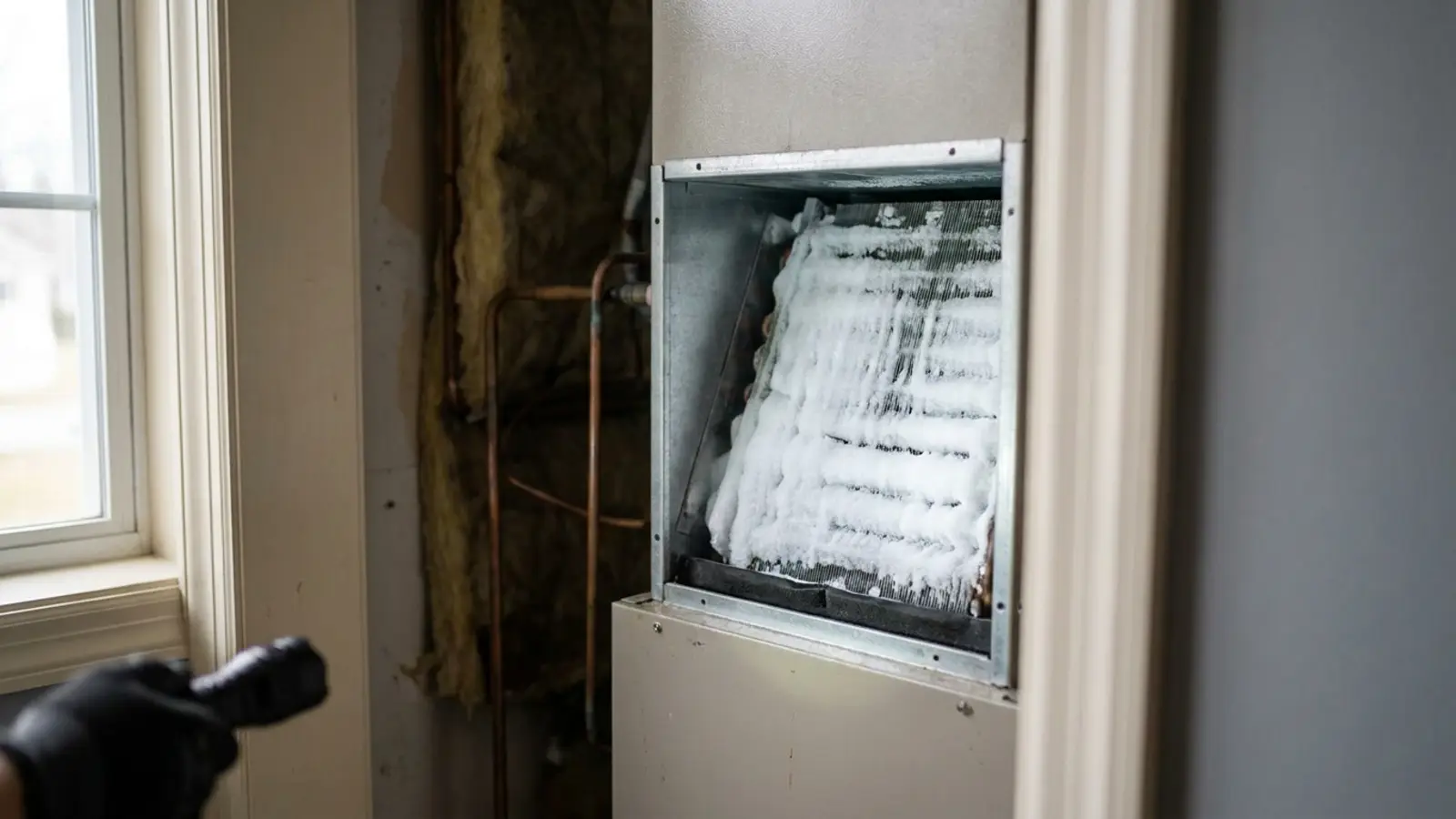
Where the ice forms is diagnostic. Ice confined to the indoor evaporator coil usually means an airflow restriction — filter, blower or dirty coil. Ice that starts at the outdoor unit's service valves and creeps back along the large copper line usually means low refrigerant charge or a metering problem. Ice covering the outdoor coil in summer points to a defrost, fan or charge fault on a heat pump. In every case, shut cooling off, run the fan to thaw, and have the cause diagnosed before restarting.
Check these 3 things first
- 1Note exactly where ice appears: indoor coil, line set, or outdoor unit.
- 2Turn cooling off and set the fan to ON to thaw before inspecting further.
- 3Confirm the outdoor fan is spinning whenever the compressor runs.
How Serious Is This?
GREEN
Usually Manageable
Often resolved with basic homeowner checks and routine maintenance.
YELLOW — this issue's severity level
Inspection Recommended(this issue)
Worth a professional diagnosis soon to avoid a larger repair.
RED
Potentially Serious
Stop using the system and get professional help right away.
Most Likely Causes of an AC Unit Freezing Up
1. Airflow restriction at the indoor unit
Filter, dirty coil, weak blower or closed registers — produces ice on the indoor coil first.
2. Low refrigerant charge
Ice tends to start at the metering device or at the outdoor service valves and spread along the suction line.
3. Restricted metering device
A partially blocked TXV or orifice starves part of the coil, causing patchy frost.
4. Failed outdoor fan on a heat pump
Poor outdoor airflow can push a heat pump into abnormal operation and cause icing on the outdoor coil.
5. Dirty evaporator coil
Fins bridged with dust behave exactly like a clogged filter.
6. Extended low-load operation
Long run times at very low indoor load or cool outdoor temperature drive coil temperature below freezing.
Safe Homeowner Checks for an AC Unit Freezing Up
- Note exactly where the ice is: indoor coil, indoor line set, outdoor valves, or outdoor coil.
- Switch cooling OFF and the fan to ON.
- Replace the filter.
- Check the outdoor fan is running when the compressor runs.
- Place towels or a container under the indoor unit for thaw water if the pan is small.
- Confirm all registers are open.
Stop and get help if you notice
- • Ice on the outdoor unit during cooling season.
- • Repeated icing after each thaw.
- • Water damage forming below the indoor unit during thaw.
2-Minute Tests for an AC Unit Freezing Up
Each test isolates one specific cause so you know what you are dealing with before anyone quotes you a repair. Stop immediately if anything feels unsafe.
Indoor coil ice location check
About 5 minutesTools: Flashlight
Tests for: Airflow restriction at the indoor unit
- Remove the access panel nearest the indoor coil if it opens without tools.
- Shine a light on the coil fins and note whether ice is present there specifically.
- Check the filter and blower for related restrictions.
- Normal result
- The coil is clean and free of frost.
- Problem result
- Frost or ice coats the indoor coil fins.
What it means: Ice confined to the indoor coil strongly suggests an airflow problem such as a dirty filter, dirty coil, or weak blower.
Line set ice tracing
About 5 minutesTools: Flashlight
Tests for: Low refrigerant charge
- Follow the larger insulated copper line from the indoor unit toward outdoors.
- Look for frost starting near the outdoor service valves.
- Note whether ice appears to travel along the line rather than staying at the coil.
- Normal result
- The line set is dry with intact insulation and no frost.
- Problem result
- Frost creeps along the line toward or from the outdoor unit.
What it means: Ice migrating along the suction line toward the outdoor valves is a classic sign of low refrigerant charge or a metering device fault.
Outdoor coil observation during cooling
About 4 minutesTools: None
Tests for: Failed outdoor fan on a heat pump
- Watch the outdoor unit during a cooling call.
- Confirm the outdoor fan is spinning while the compressor runs.
- Check for frost forming on the outdoor coil itself, which is unusual in cooling mode.
- Normal result
- The outdoor fan spins continuously and the outdoor coil stays dry.
- Problem result
- The outdoor fan is stalled, or frost appears on the outdoor coil during cooling.
What it means: Ice on the outdoor coil during cooling season is unusual and often points to a fan, control, or charge fault needing prompt diagnosis.
What Fixing an AC Unit Freezing Up Typically Costs
Filter replacement
- DIY
- $0 (filter only)
- Professional
- Included in maintenance
- Typical time
- 5 minutes
Coil cleaning (indoor or outdoor)
- DIY
- Not typically DIY
- Professional
- $150-$400
- Typical time
- 1-2 hours
Metering device replacement
- DIY
- Not a DIY repair
- Professional
- $400-$900
- Typical time
- 2-3 hours
Refrigerant leak diagnosis
- DIY
- Not a DIY repair
- Professional
- $150-$350 diagnostic
- Typical time
- 1-2 hours
Evaporator coil leak repair
- DIY
- Not a DIY repair
- Professional
- $1,000-$2,800+
- Typical time
- 3-6 hours
Condenser fan motor replacement
- DIY
- Not a DIY repair
- Professional
- $350-$700
- Typical time
- 1-2 hours
| Problem | DIY cost | Professional cost | Typical time |
|---|---|---|---|
| Filter replacement | $0 (filter only) | Included in maintenance | 5 minutes |
| Coil cleaning (indoor or outdoor) | Not typically DIY | $150-$400 | 1-2 hours |
| Metering device replacement | Not a DIY repair | $400-$900 | 2-3 hours |
| Refrigerant leak diagnosis | Not a DIY repair | $150-$350 diagnostic | 1-2 hours |
| Evaporator coil leak repair | Not a DIY repair | $1,000-$2,800+ | 3-6 hours |
| Condenser fan motor replacement | Not a DIY repair | $350-$700 | 1-2 hours |
Ranges are national estimates for planning only. Local labor rates, equipment access and parts availability change what you will actually be quoted.
Working Through an AC Unit Freezing Up
Is the ice mainly on the indoor coil?
Yes: Airflow is the leading suspect — filter, blower, coil.
No: Continue.
Does the ice extend along the large copper line to the outdoor unit?
Yes: Refrigerant charge or metering device is the leading suspect — service required.
No: Continue.
Is the outdoor coil iced during cooling?
Yes: Unusual — call for service; this can indicate a control, fan or charge fault.
No: Thaw, replace the filter and monitor for recurrence.
What the technician will check
- Charge evaluation with superheat and subcooling.
- Metering device performance.
- Indoor airflow measurement.
- Coil cleanliness both sides.
- Leak search when charge is low.
Repair considerations
- • Evaporator coil leaks are among the more expensive sealed-system repairs.
- • Metering device replacement is moderate and often paired with charge correction.
- • System age and refrigerant type strongly affect whether repair or replacement makes sense.
What this actually means
A split system has one cold coil indoors and one hot coil outdoors during cooling. Ice indoors is expected physics gone wrong. Ice outdoors during cooling is more unusual and usually indicates a refrigerant or control fault, since that coil should be rejecting heat, not absorbing it.
When to Call an HVAC Professional About an AC Unit Freezing Up
- Ice reaches the outdoor unit.
- Icing recurs after a proper thaw and filter change.
- You find water damage from a previous thaw.
- The outdoor fan is not running.
Preventing an AC Unit Freezing Up From Coming Back
- • Regular filter changes and annual coil inspection.
- • Verify charge annually rather than waiting for symptoms.
- • Keep the outdoor unit clear and the fan functional.
Worth doing yourself
- • Note precisely where the ice is located before calling for service.
- • Thaw with fan-only operation and replace the filter.
- • Place towels or a container under the indoor unit to catch thaw water.
- • Keep the outdoor unit clear of debris and vegetation.
Do not waste money on
- • Restarting cooling before the ice has fully melted from every location.
- • Assuming a filter change will fix ice found on the outdoor coil.
- • Attempting to inspect or clean the outdoor fan while it could start unexpectedly.
Related Problems: AC Unit Freezing Up
- YELLOW — Inspection RecommendedAC FreezingWhy Is My AC Freezing Up?Read this next if ice is actively forming during operation and the visitor wants the mechanism plus the immediate corrective action.View answer
- YELLOW — Inspection RecommendedAC FreezingWhy Is My AC Frozen?Read this next if system is already fully frozen and non-functional right now — visitor needs emergency thaw instructions before any diagnosis.View answer
- YELLOW — Inspection RecommendedAC Water LeaksWhy Is My AC Unit Leaking Water?Read this next if water is visibly originating at the equipment cabinet — indoor air handler or outdoor condenser — rather than appearing elsewhere in the home.View answer
- YELLOW — Inspection RecommendedAC Not CoolingWhy Is My AC Not Blowing Air?Read this next if no air movement at all at the registers — an airflow and blower problem rather than a temperature problem.View answer
- YELLOW — Inspection RecommendedAC Not CoolingWhy Is My AC Unit Not Blowing Cold Air?Read this next if focus on the AC equipment itself — indoor air handler and outdoor condenser hardware — rather than on the vent experience.View answer
- YELLOW — Inspection RecommendedAC Water LeaksWhy Is My AC Leaking Water From the Bottom?Read this next if water is emerging specifically at the base of the unit — drain pan, cabinet base and overflow path are the focus.View answer
- All AC Freezing problemsBrowse category
Frequently Asked Questions About an AC Unit Freezing Up
Guidance this page draws on
- ACCA — Location-based diagnostic approach to coil icing.
- U.S. EPA — Refrigerant leak repair and handling requirements.