
Why Is My AC Unit Leaking Water?
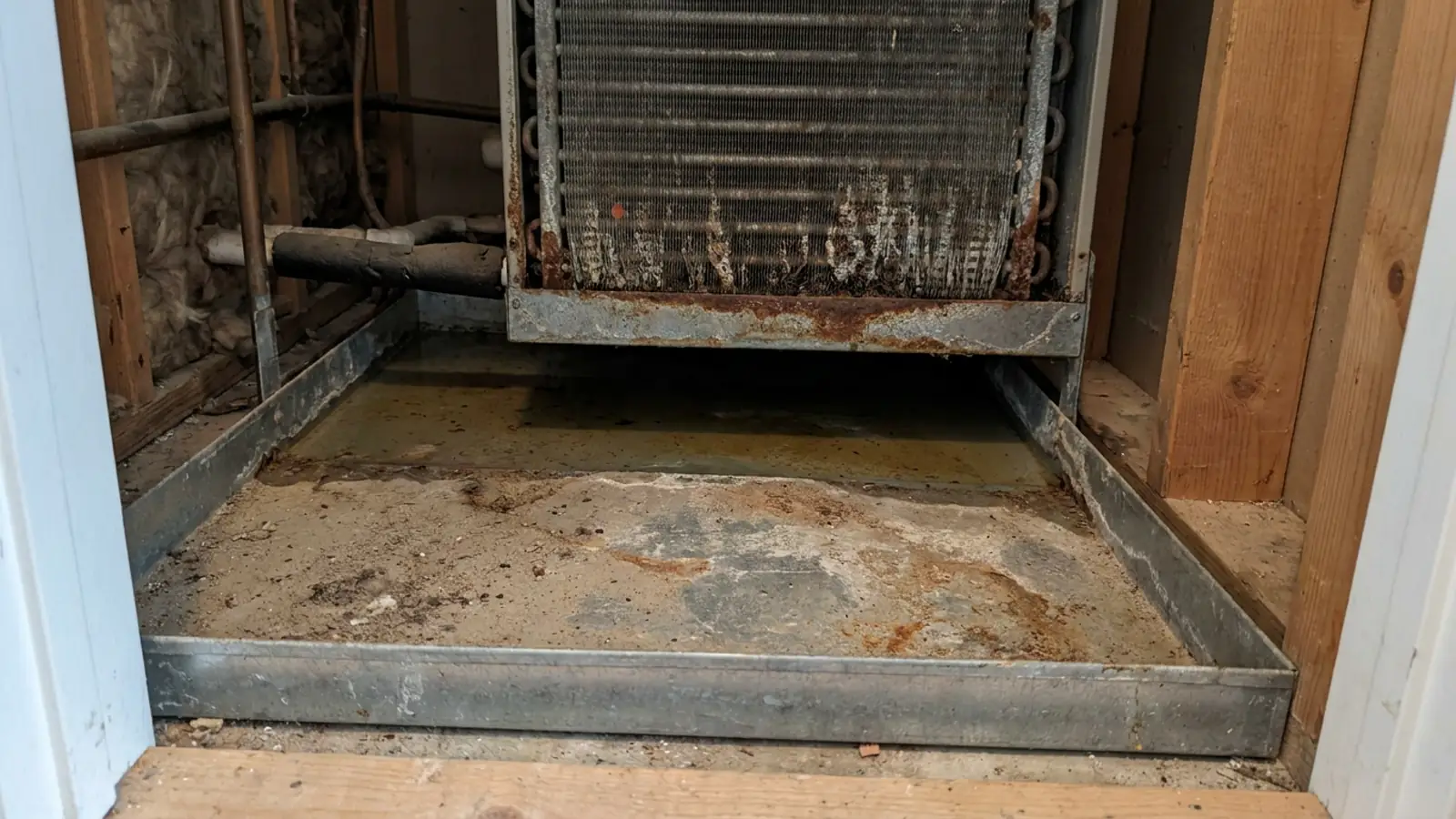
Causes, safe checks and when to call a professional
Expert Answer: AC Unit Leaking Water
Start by identifying which unit is leaking. Water at the outdoor condenser is often completely normal — condensation, rain runoff, or heat-pump defrost water. Water at the indoor air handler or furnace cabinet is not normal and points to the condensate system: a clogged drain, an overflowing or corroded pan, a disconnected drain fitting, or a coil that has iced and is thawing. Shut cooling off if water is escaping the cabinet, and check the drain pan first.
Check these 3 things first
- 1Determine whether the water is at the indoor cabinet or the outdoor condenser.
- 2Open the indoor unit's access panel and look at the pan condition.
- 3Check the outdoor unit for a legitimate, expected condensation drip.
How Serious Is This?
GREEN
Usually Manageable
Often resolved with basic homeowner checks and routine maintenance.
YELLOW — this issue's severity level
Inspection Recommended(this issue)
Worth a professional diagnosis soon to avoid a larger repair.
RED
Potentially Serious
Stop using the system and get professional help right away.
Most Likely Causes of an AC Unit Leaking Water
1. Blocked condensate drain at the indoor cabinet
Pan fills, water finds the lowest cabinet seam and runs out. The most common indoor-unit leak by far.
2. Rusted or cracked drain pan
Older air handlers have metal pans that corrode. Water escapes at the corrosion point rather than the drain.
3. Improper pan slope or a disconnected trap
A pan that is not pitched to the drain, or a missing trap, causes standing water and inconsistent drainage.
4. Frozen coil thawing inside the cabinet
Meltwater exceeds the pan capacity and spills out of the unit.
5. Blower pushing water off the coil
Excessive airflow or a badly fitted coil can blow condensate droplets past the pan into the duct or cabinet.
6. Normal condensation at the outdoor unit
Humid air contacting cold refrigerant lines and valves creates dripping at the outdoor cabinet. This is expected.
Safe Homeowner Checks for an AC Unit Leaking Water
- Determine whether the leak is at the indoor cabinet or the outdoor unit.
- Open the accessible area around the indoor unit and look at the drain pan for standing water.
- Trace the drain line to its exit point and check for a steady drip outdoors.
- Inspect the cabinet base and seams for rust or water tracks.
- Replace the filter and look for ice on the coil.
- Turn cooling off if water is escaping continuously.
Stop and get help if you notice
- • Rust stains inside the cabinet indicating a long-running leak.
- • Water contacting the blower motor or control board.
- • Sagging ceiling below an attic unit.
2-Minute Tests for an AC Unit Leaking Water
Each test isolates one specific cause so you know what you are dealing with before anyone quotes you a repair. Stop immediately if anything feels unsafe.
Check indoor cabinet drainage
About 10 minutesTools: Flashlight
Tests for: Blocked condensate drain at the indoor cabinet
- Open the indoor cabinet access panel.
- Look at the drain pan beneath the coil for standing water.
- Trace the drain line from the pan to its outdoor exit.
- Run the system for several minutes and watch for water movement.
- Normal result
- Water drains steadily and the pan stays shallow.
- Problem result
- Water rises in the pan and does not move toward the outlet.
What it means: A rising pan level with no outdoor flow confirms a blocked line at the indoor cabinet.
Inspect the pan for corrosion
About 5 minutesTools: Flashlight
Tests for: Rusted or cracked drain pan
- Turn the system off.
- Look closely at the pan's floor and seams for rust flakes or dark stains.
- Press gently on any suspicious spot to check for softness.
- Look underneath the cabinet for drip marks or water tracks.
- Normal result
- The pan is solid with no rust-through spots or stains below it.
- Problem result
- Rust holes, soft spots, or dried water tracks are visible.
What it means: A corroded pan leaks regardless of drain condition and needs replacement.
Check for coil ice in the cabinet
About 5 minutesTools: Flashlight
Tests for: Frozen coil thawing inside the cabinet
- Turn the system off and open the panel.
- Look at the coil fins for frost or ice buildup.
- Check the filter for heavy dust loading.
- Feel the return airflow strength at the grille.
- Normal result
- No ice is present and the filter is reasonably clean.
- Problem result
- Ice coats the coil or the filter is clogged.
What it means: Ice inside the cabinet means the overflow is meltwater tied to an airflow restriction.
Confirm outdoor dripping is expected
About 5 minutesTools: None
Tests for: Normal condensation at the outdoor unit
- Observe the outdoor unit during a humid afternoon while it runs.
- Note where the water is coming from — the refrigerant lines or valve area versus the ground beneath the cabinet.
- Check that the ground below is not pooling excessively or eroding.
- Confirm there is no oily residue mixed with the water.
- Normal result
- A light drip from cold copper lines or valves with no oily sheen.
- Problem result
- Heavy pooling, oily residue, or water from a heat-pump unit in cooling mode.
What it means: Light, clear dripping from cold surfaces is ordinary condensation; oily residue points elsewhere.
What Fixing an AC Unit Leaking Water Typically Costs
Drain line clearing (indoor cabinet)
- DIY
- $5-$15
- Professional
- $75-$200
- Typical time
- 30-60 minutes
Float switch installation/replacement
- DIY
- Not recommended (wiring)
- Professional
- $100-$250
- Typical time
- 1 hour
Drain pan replacement
- DIY
- Not a DIY repair
- Professional
- $300-$800
- Typical time
- 2-4 hours
Secondary drain pan install (attic units)
- DIY
- Not a DIY repair
- Professional
- $150-$350
- Typical time
- 1-2 hours
Filter and airflow correction
- DIY
- $10-$30
- Professional
- $100-$250
- Typical time
- 30 minutes
| Problem | DIY cost | Professional cost | Typical time |
|---|---|---|---|
| Drain line clearing (indoor cabinet) | $5-$15 | $75-$200 | 30-60 minutes |
| Float switch installation/replacement | Not recommended (wiring) | $100-$250 | 1 hour |
| Drain pan replacement | Not a DIY repair | $300-$800 | 2-4 hours |
| Secondary drain pan install (attic units) | Not a DIY repair | $150-$350 | 1-2 hours |
| Filter and airflow correction | $10-$30 | $100-$250 | 30 minutes |
Ranges are national estimates for planning only. Local labor rates, equipment access and parts availability change what you will actually be quoted.
Working Through an AC Unit Leaking Water
Is the leaking unit indoors?
Yes: Treat it as a condensate drainage fault requiring prompt attention.
No: Outdoor water is often normal; confirm it is not a plumbing or roof drainage issue.
Is there standing water in the drain pan?
Yes: The drain is blocked or the pump failed.
No: Check for a cracked pan, a loose fitting, or water being blown off the coil.
Is there ice on the coil?
Yes: The leak is meltwater — fix the freezing cause.
No: Focus on pan and drain condition.
What the technician will check
- Drain line clearing and trap verification.
- Pan condition and slope inspection.
- Float switch function.
- Coil and airflow evaluation if icing is present.
- Cabinet seal and insulation condition.
Repair considerations
- • Secondary drain pans and float switches are inexpensive insurance for attic installations.
- • Pan replacement labor can be substantial on older equipment.
- • If the unit is old and the pan is rusted through, replacement may be worth pricing.
What this actually means
The indoor cabinet is where moisture is created and collected, so any water escaping it means the collection or drainage path failed. The outdoor cabinet has no condensate system during cooling, so water there generally comes from the weather or from normal moisture in the air — unless the unit is a heat pump, which does produce meltwater in heating mode.
When to Call an HVAC Professional About an AC Unit Leaking Water
- The pan is corroded or cracked.
- The drain will not clear.
- Water is contacting electrical parts.
- The coil freezes repeatedly.
Preventing an AC Unit Leaking Water From Coming Back
- • Annual drain flushing.
- • Install or verify a float safety switch, especially for attic units.
- • Keep the filter current to prevent icing.
Worth doing yourself
- • Replace the filter on a regular schedule to prevent coil icing.
- • Flush the indoor drain line with vinegar during cooling season.
- • Wipe the outdoor unit's base clear of debris that traps water.
- • Verify the outdoor pad is level so runoff drains away from the unit.
Do not waste money on
- • Assuming any water at the outdoor unit is a problem before checking for oily residue or heat-pump defrost.
- • Ignoring a corroded indoor pan because the leak seems minor now.
Related Problems: AC Unit Leaking Water
- YELLOW — Inspection RecommendedAC Water LeaksWhy Is My AC Leaking Water?Read this next if broad water-leak diagnosis with no location specified yet — the visitor needs to identify the source before anything else.View answer
- YELLOW — Inspection RecommendedAC Water LeaksWhy Is My AC Leaking Water From the Bottom?Read this next if water is emerging specifically at the base of the unit — drain pan, cabinet base and overflow path are the focus.View answer
- YELLOW — Inspection RecommendedAC Water LeaksWhy Is My AC Dripping Water?Read this next if active, ongoing dripping observed in real time — emphasis on the drip location and whether that specific drip is normal.View answer
- YELLOW — Inspection RecommendedAC Water LeaksWhy Is My AC Leaking Water Inside?Read this next if water is appearing indoors and the visitor is concerned about interior damage — emphasis on containment and stopping the water.View answer
- YELLOW — Inspection RecommendedAC FreezingWhy Is My AC Unit Freezing Up?Read this next if ice located on the physical unit — indoor cabinet or outdoor condenser and line set — with emphasis on where the ice appears and what each location means.View answer
- YELLOW — Inspection RecommendedAC Water LeaksWhy Is My AC Leaking?Read this next if leak type is unidentified — the visitor has not established whether it is water, refrigerant or oil, so the page must help classify the leak.View answer
- All AC Water Leaks problemsBrowse category
Frequently Asked Questions About an AC Unit Leaking Water
Guidance this page draws on
- HVAC manufacturer service literature — Air handler drain pan and float switch specifications.
- ACCA — Condensate management standards for residential systems.